
Triple-zero roulette: what the 7.69% edge costs in 20 spins
Compare exact 20-spin results on single-, double- and triple-zero roulette, plus the cost of a $5 triple-zero table versus $10 double-zero.
Published September 6, 2026. Updated September 6, 2026.
Triple-zero roulette has a 7.69% house edge on a standard red or black bet that loses fully on green. Twenty $10 bets have an expected loss of $15.38. The same bets cost $10.53 on double-zero and $5.41 on single-zero, on average.
The stake also matters. A $5 triple-zero bet has a lower expected dollar loss than a $10 double-zero bet, despite its worse percentage return. Moving to a higher minimum can remove the saving from a better wheel.
Recent X discussion criticizes triple-zero tables and compares small bets with larger bets on better rules. Those posts are audience signals. Our September 6 calculation holds the spin count fixed, then changes the wheel and stake separately. It does not infer a player's result from a social post or a casino advertisement.
Three green pockets create the 7.69% edge
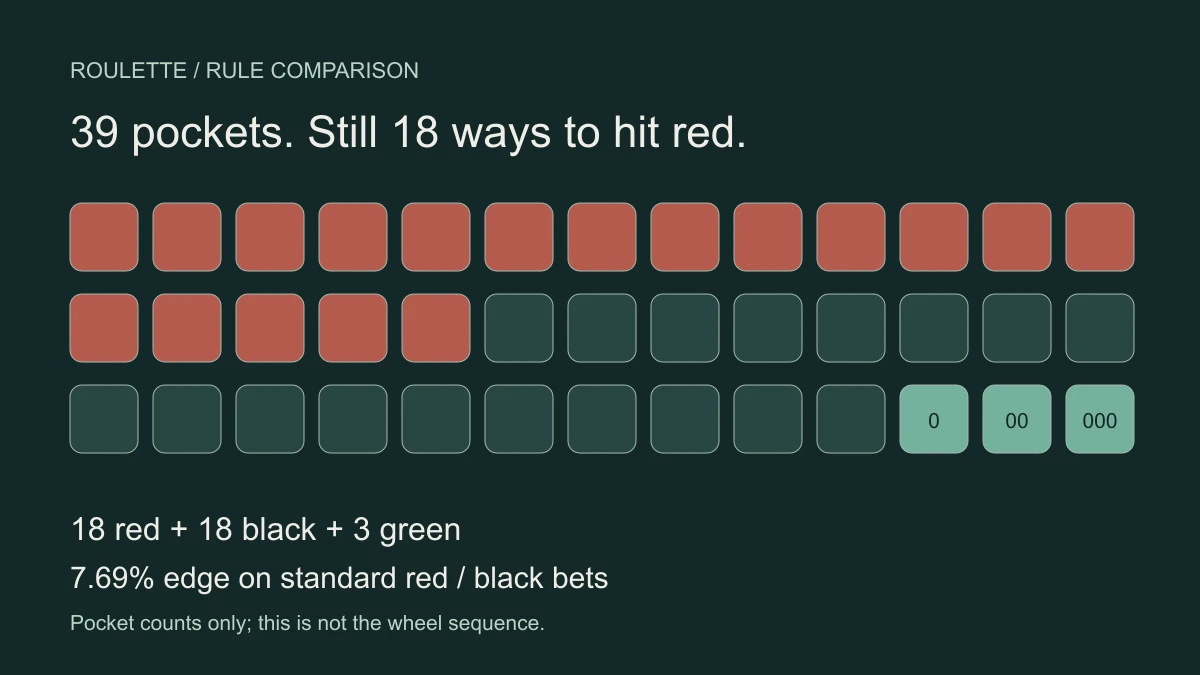
A triple-zero wheel has 39 pockets: 18 red, 18 black and three green. The third green pocket may show a casino logo instead of 000. Count the pockets and read the rules rather than relying on the game name.
For a $10 red bet, 18 pockets produce a $10 profit and 21 produce a $10 loss. This calculation assumes equal pocket probabilities and a standard 1:1 profit payout. It excludes rebates, bonuses, multipliers and half-back rules.
Expected profit per spin = (18 × $10 - 21 × $10) / 39 = -$0.76923
The expected loss divided by the $10 stake is 3/39, or 7.6923%. Michael Shackleford's published roulette analysis gives the same edge. A 7.69% edge is a fraction of total money wagered, so repeated bets with the same chips each count toward turnover.
| Standard wheel | Red wins | House edge on red | Expected loss on twenty $10 bets |
|---|---|---|---|
| Single-zero | 18/37 | 2.7027% | $5.41 |
| Double-zero | 18/38 | 5.2632% | $10.53 |
| Triple-zero | 18/39 | 7.6923% | $15.38 |
The triple-zero cost is 46.15% higher than double-zero at equal stakes and spin counts. It is about 2.85 times the single-zero cost. These comparisons use exact fractions before rounding.
Twenty spins still allow winning sessions on every wheel
Now assume a player makes exactly twenty $10 red bets. The stake never changes. The player has enough money to complete all twenty bets and does not stop after a win or loss. Spins are independent, and the probability of red stays fixed.
Finishing ahead requires at least 11 wins. Ten wins produce a zero net result. Nine or fewer produce a loss. The largest possible loss in this fixed example is $200; the expected loss is much smaller than that limit.
We used the binomial formula published by NIST: P(k wins) = C(20,k) × p^k × (1-p)^(20-k). For triple-zero, p = 18/39. Adding the probabilities for 11 through 20 wins gives the chance of finishing ahead.
| Wheel | Finish ahead | Finish even | Finish behind |
|---|---|---|---|
| Single-zero | 36.50% | 17.49% | 46.01% |
| Double-zero | 32.23% | 17.14% | 50.63% |
| Triple-zero | 28.38% | 16.60% | 55.01% |
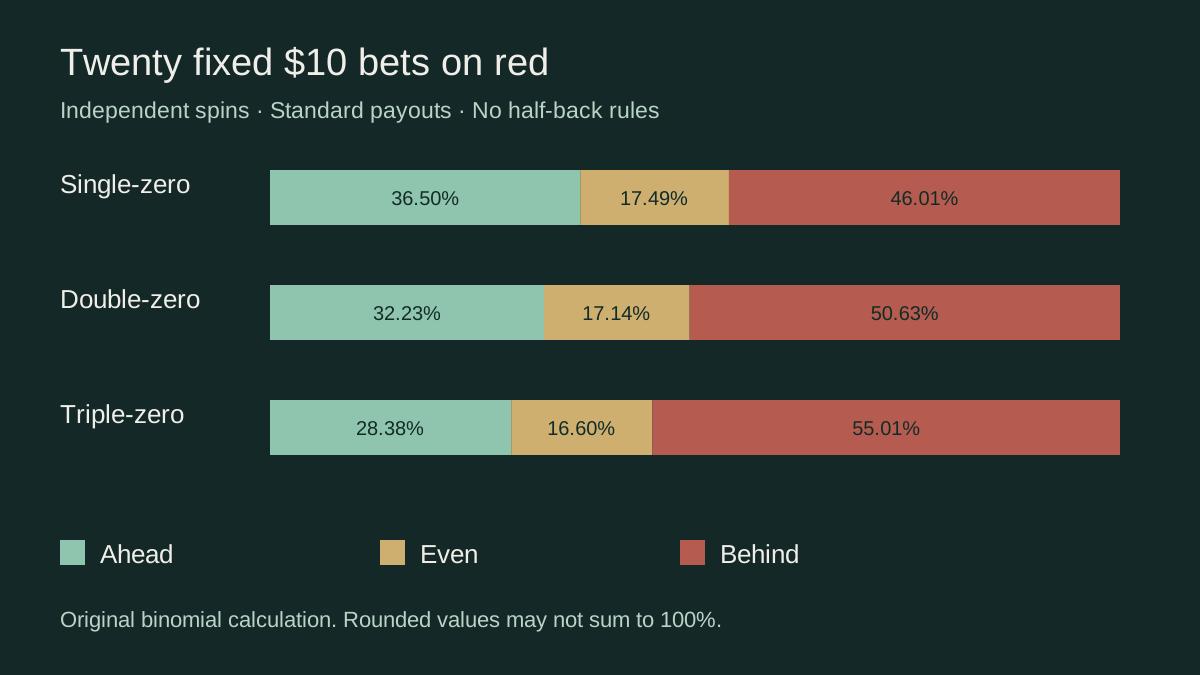
The triple-zero player finishes ahead in about 28 of 100 modeled sessions. That does not remove the negative average return. Winning sessions coexist with a house edge because the probabilities and amounts of all outcomes determine the average. A different spin count or stopping rule needs a new distribution.
A lower house edge does not justify doubling the stake
Compare a hypothetical $5 triple-zero table with a $10 double-zero table. At 60 spins, the first has $300 of turnover and the second has $600. The expected losses are $23.08 and $31.58 respectively.
The double-zero wheel has better rules, but the doubled stake costs more in dollars over the same number of spins. These are comparison inputs, not a claim about the current minimum at any casino. The calculation also does not say that one option fits your budget.
To match the $5 triple-zero expected cost on double-zero, solve stake × 2/38 = $5 × 3/39. The answer is $7.31 per spin. On single-zero without half-back, the matching stake is $14.23. A higher stake than those values increases expected dollar loss at the same pace.
You can compare single-zero and double-zero bets in our roulette calculator. Keep the number of bets fixed when comparing expected costs. More spins can outweigh a lower cost per spin.
For a single-zero wheel with half-back on zero, our la partage comparison shows the cost of 100 ten-dollar even-money bets.
Craps has a related denominator problem. Our pass-line and odds model holds the line stake fixed and shows why a lower combined house edge can leave expected dollar loss unchanged.
For an online or crypto casino game, inspect its own paytable before using these fractions. A logo pocket, reduced payout or multiplier feature can change the calculation. Deposit currency alone does not change the 18 winning pockets in this model. Set a total loss limit before play and stop when that limit is reached.
Sources checked September 6, 2026: Wizard of Odds roulette rules and original mathematical analysis, NIST binomial distribution, and current X discussion of triple-zero roulette. X is anecdotal. The tables and charts are our calculations under the stated rules, not observed casino session data.
On a double-zero wheel, the first-five bet also pays less than five equal straight bets covering the same numbers.

Yuki Tanaka
Live Casino Reviewer · 7 years
Yuki compares live dealer lobbies with an eye on table limits, provider coverage, mobile stability, and the small interface choices that decide whether a session feels smooth or irritating. She also reviews blackjack, roulette, baccarat, and game-show tables. She keeps handwritten tasting notes for coffee, although the margins usually end up full of table-limit calculations.
Read next
Baccarat tie bets: 8 to 1 versus 9 to 1 in 20 hands
Compare baccarat tie bet payouts with exact eight-deck odds. Our 20-hand model shows how 9 to 1 changes expected loss and break-even results.
5 min read
Blackjack surrender: saving 80 cents on a bad $20 hand
With 16 against a dealer 10, late surrender can lose less than hitting. Our $20 example compares the cost and explains when the rule applies.
3 min read
10% bonus contribution: why $2,000 becomes $20,000
Only 10% of a bet may count toward a casino bonus. Our $100 example shows how a lower game edge can still produce a higher wagering cost.
3 min read