
Legal US Online Poker Pools in September 2026
See which states can share regulated online poker traffic, why compact membership does not create one universal pool, and what players must check before joining a table.
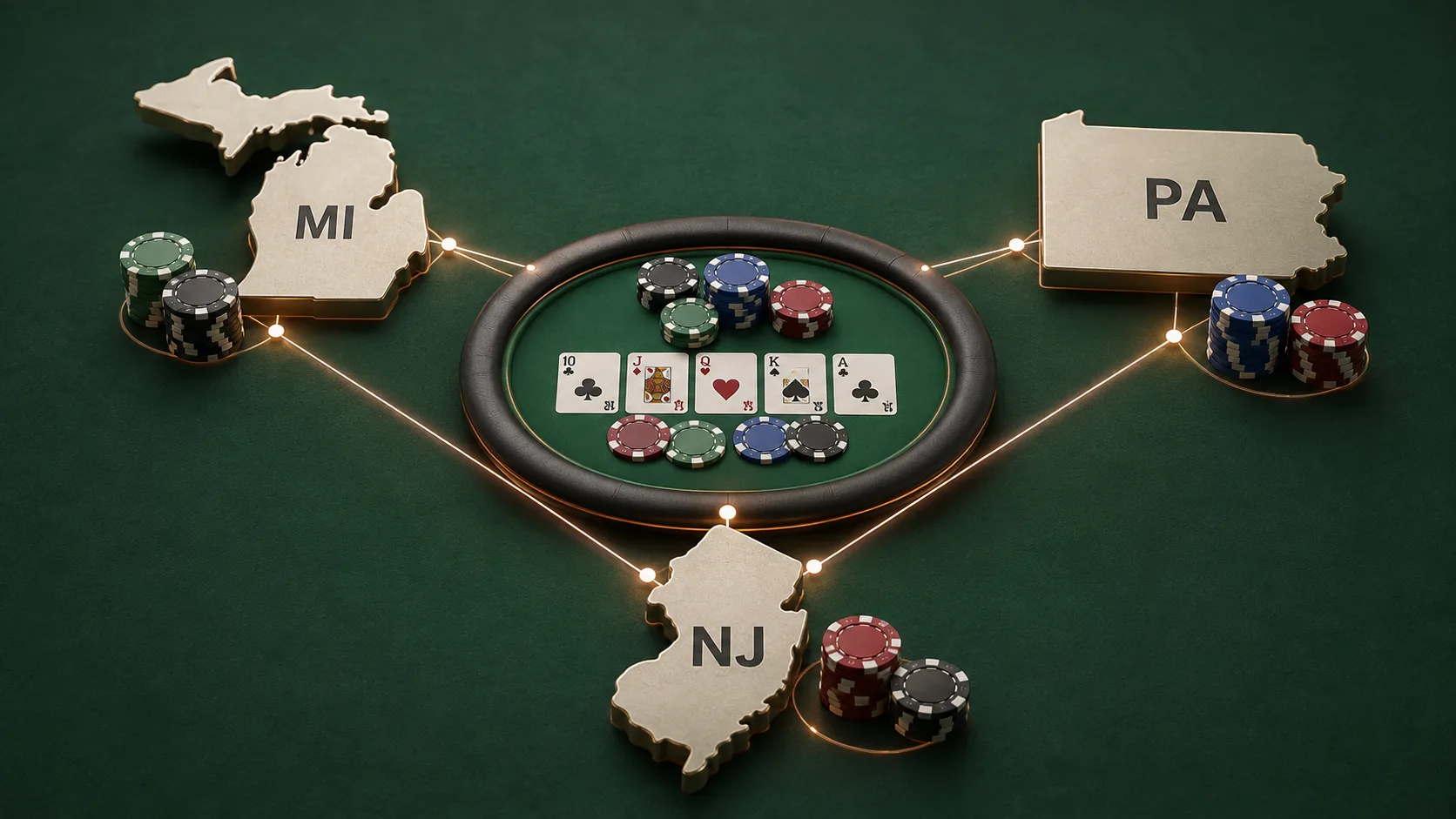
A legal online poker state does not automatically give every player access to every shared table. The state must belong to the Multi-State Internet Gaming Agreement, and each operator still needs approval for its own network.
This distinction matters in September 2026. The Michigan Gaming Control Board says DraftKings began sharing poker traffic between Michigan, Pennsylvania and New Jersey on July 8, 2026. The launch added another approved network, but it did not merge every regulated US poker site into one pool.
Six states can share traffic under the compact
Michigan joined Delaware, Nevada and New Jersey in the agreement in 2022. West Virginia joined in 2023, and Pennsylvania began multi-state play in April 2025. These six states can now support approved shared poker networks.
Compact membership is permission at the state level. It does not mean that all six states appear in each operator's lobby. A poker operator must hold the required state licences, connect its platform and receive approval before it can combine players.
The current DraftKings approval is a clear example. Michigan's regulator approved a three-state network covering Michigan, Pennsylvania and New Jersey. A player in another compact state should not assume that the same tables are available there.
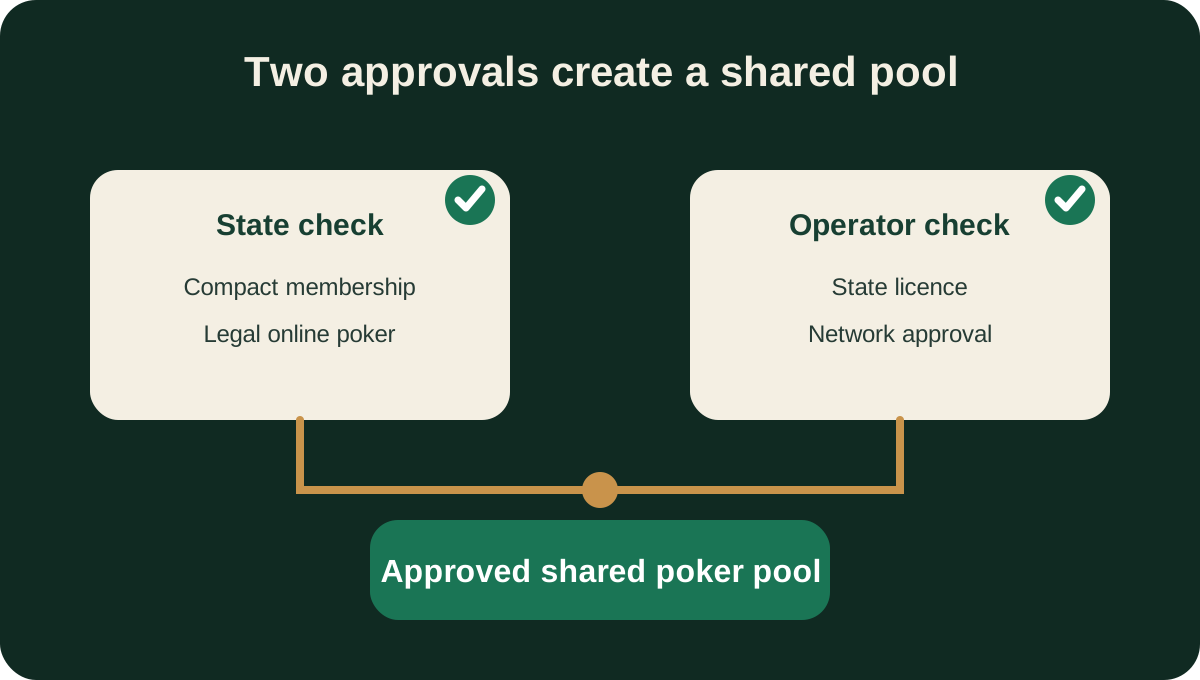
A shared compact does not create one universal lobby
Think of the agreement as a set of roads. It allows approved traffic to cross state lines, but each operator chooses which roads to build and must get them approved.
Two players can live in compact states and still see different games because:
- their states may license different poker operators;
- one operator may share traffic across three states while another uses two;
- a network may offer a tournament in one approved market but not another;
- geolocation, age and account checks still apply to each player.
The operator's live terms and the state regulator's approved operator list are stronger evidence than an old comparison page or a forum comment. Check both before you deposit.
More players can change the tournament schedule
A larger pool can support more tournament entries, cash tables and stake levels. It does not guarantee a specific prize pool or a softer field.
Consider a simple example. An isolated $50 tournament with 450 entries creates $22,500 in gross buy-ins before fees. If an approved shared pool lifts the field to 1,050 entries, the same buy-in creates $52,500.
| Example field | Entries | Buy-in before fee | Gross buy-ins |
|---|---|---|---|
| Isolated pool | 450 | $50 | $22,500 |
| Shared pool | 1,050 | $50 | $52,500 |
This is an illustration, not a forecast for any named room. Tournament guarantees, fee structures and late registration rules still decide the final value.
Cash games can also benefit from more traffic. A larger pool may keep more tables running outside peak hours. It can also attract stronger regular players. Traffic is useful, but it is not the only selection factor.
Check the exact room before you install it
Use this four-step check for any regulated US poker room:
- Confirm that online poker is legal in your state.
- Find the operator on the state regulator's current approved list.
- Read the operator's current multi-state terms or the regulator's approval notice.
- Confirm that you can pass the age, identity and geolocation checks before you deposit.
Our poker room finder can help you compare rooms by location and payment needs. Treat it as a discovery tool. The regulator and the operator control current eligibility.
If a site accepts a deposit without confirming your location, that does not prove it is a regulated US room. Michigan's regulator maintains separate legal and illegal operator information for this reason.
Pool size is only one part of room selection
Before you choose a room, compare the full cost and playing conditions:
| Check | Why it matters |
|---|---|
| Tournament fee | A larger field does not make a high fee cheaper |
| Cash-game rake | More traffic can still come with a costly rake cap |
| Game selection | A large Hold'em pool may offer little Omaha traffic |
| Withdrawal rules | Fast deposits do not guarantee fast cash-outs |
| Responsible gaming tools | Deposit limits and self-exclusion must be easy to find |
Forum discussions on r/poker show clear player interest in regulated state leaderboards and shared fields. They also show frustration when a legal market remains small. These posts are useful signals, but they do not replace a regulator notice or current lobby data.
The useful question is not only, "Is my state in the compact?" Ask, "Which approved operator connects my state to which live network today?"
Online poker involves financial risk. Use licensed operators, set a fixed deposit limit and do not play with money needed for bills or debt payments.
Sources for the current state and operator checks
- Michigan Gaming Control Board: DraftKings multi-state poker approval, published July 13, 2026.
- Michigan Gaming Control Board: multistate internet poker, checked September 4, 2026.
- Michigan Gaming Control Board: authorized online gaming providers, checked September 4, 2026.

Elena Volkov
Industry & Regulation Analyst · 7 years
Elena tracks the regulatory landscape for crypto poker across every major jurisdiction. From Curacao licensing changes to emerging frameworks in Latin America, she provides context that helps players and operators understand what's legal, what's gray, and what's shifting. Her reporting on room closures and payment processor changes has earned her a reputation as the most reliable news source in the crypto poker space. Hits the trails on weekends to clear her head.