
Blackjack insurance: what even money costs on a $100 hand
An exact six-deck calculation compares a guaranteed $100 blackjack win with a $103.88 average return when you decline even money.
Published September 7, 2026. Updated September 7, 2026.
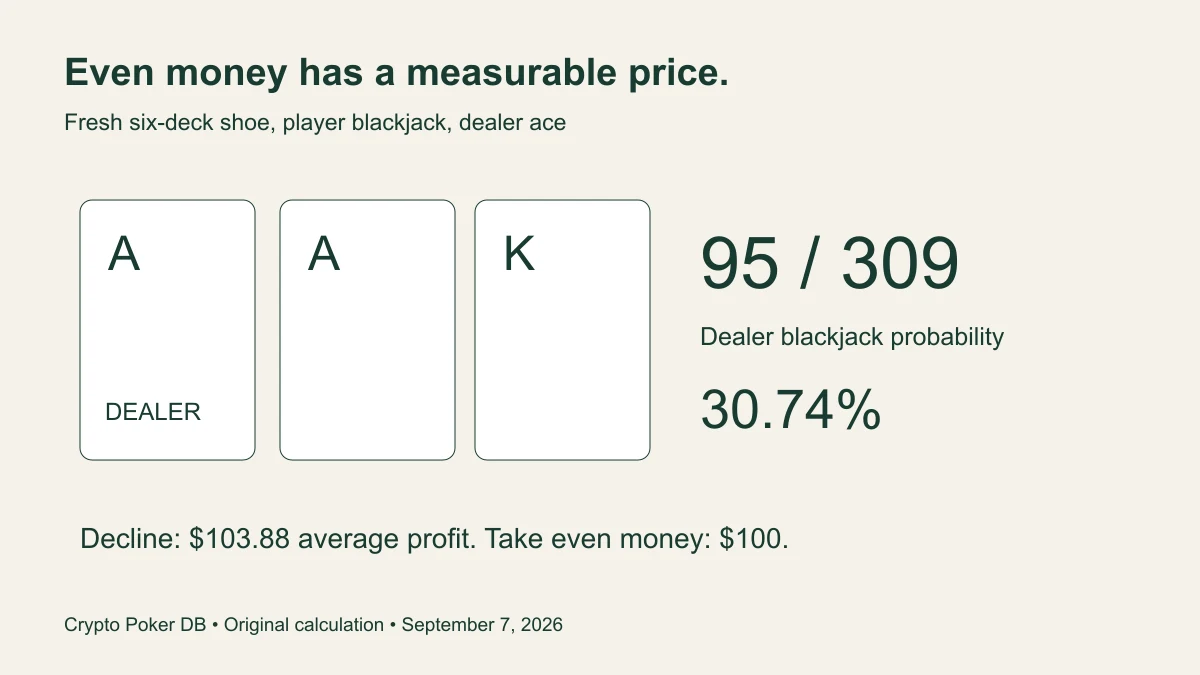
On a fresh six-deck shoe, a $100 natural blackjack against a dealer ace has an expected profit of $103.88 if you decline even money. Accepting even money fixes the profit at $100. In this model, certainty costs $3.88 in average profit.
This is a conditional comparison after you already have blackjack. It does not mean a $100 blackjack bet earns $103.88 on average before the cards are dealt. Most starting hands are not natural blackjacks.
DraftKings Casino asked players on August 29 whether they would take even money in this situation. We calculated the price of that choice using a fresh-shoe model. Replies and recent player comments are discussion context, not evidence for the probability.
Insurance needs a ten-value card more than one third of the time
Standard insurance is a separate wager offered against a dealer ace. It pays 2 to 1 when the hidden card has a value of ten. The insurance stake can be up to half the original bet. These are the rules described in the Wizard of Odds blackjack reference.
Let p be the probability that the hole card has a value of ten. A $10 insurance wager wins $20 net with probability p and loses $10 otherwise. Its expected net result is $10 × (3p − 1). It breaks even at p = 1/3, or 33.33%.
A high total in your own hand does not by itself improve that insurance bet. What matters is the fraction of unseen cards worth ten. Your visible cards affect the fraction because they remove cards from the available pool.
| Ten-value share of unseen cards | Expected net result on $10 insurance |
|---|---|
| 25% | −$2.50 |
| 30% | −$1.00 |
| 33.33%, exactly one third | $0 |
| 35% | +$0.50 |
The positive example is a probability assumption, not an instruction to infer an advantage from a short run of low cards. To use it for a real shoe, the unseen-card composition and dealing rules must support the input.
Six decks leave 95 winning hole cards after your blackjack
Start with six complete standard decks: 312 cards, including 96 tens, jacks, queens, and kings. The visible dealer ace and your ace plus ten-value card remove three cards. There are 309 unseen cards, of which 95 can complete the dealer's blackjack.
The dealer's blackjack probability is therefore 95/309, or 30.74%. We assume these are the only exposed cards and have no information about burn cards or other hidden cards. Each unseen card is equally likely to occupy the hole-card position. This describes a fresh-shoe information state, not an average across an entire casino session.
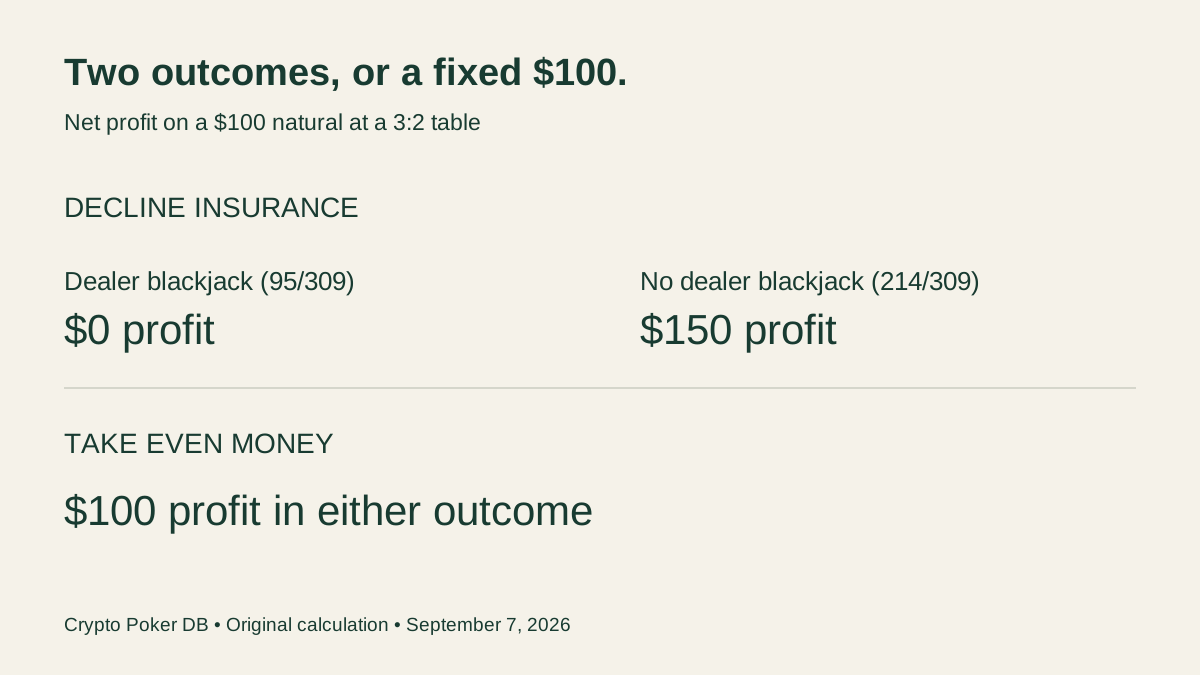
If you decline insurance at a 3:2 table, the dealer's blackjack makes your blackjack push. Otherwise, your $100 bet wins $150 net. The expected profit is $150 × (214/309) = $103.88. Returned original stakes are excluded from all profit figures here.
If you instead buy the full $50 insurance, the dealer-blackjack outcome pays $100 net on insurance while the main bet pushes. The other outcome wins $150 on the main bet but loses the $50 insurance. Either way, your combined net profit is $100. That is why full insurance on a 3:2 natural is equivalent to even money.
Changing the deck count barely changes this $3.88 cost
For d fresh decks under the same information assumptions, the unseen-card total is 52d − 3 and the ten-value total is 16d − 1. We recalculated the decision for one, two, six, and eight decks. Declining even money has a higher average profit in each case.
The advantage is about $4 per $100 natural blackjack facing an ace, not $4 per ordinary hand. The small difference between deck counts comes from removing the same three visible cards from different shoe sizes. It does not include the effect of previously exposed cards.
| Fresh decks | Dealer blackjack probability | Profit if you decline, on average | Cost of taking $100 even money |
|---|---|---|---|
| 1 | 30.61% | $104.08 | $4.08 |
| 2 | 30.69% | $103.96 | $3.96 |
| 6 | 30.74% | $103.88 | $3.88 |
| 8 | 30.75% | $103.87 | $3.87 |
Use the expected value calculator to compare a $150 profit at a 214/309 probability with a $0 profit otherwise. Keep this separate from the expected result of the original bet before the deal. If a tool asks for a loss amount, use zero for the push outcome.
The equivalence with even money depends on a 3:2 blackjack payout and standard 2:1 insurance. A 6:5 table changes the non-blackjack payoff, so full insurance no longer fixes the combined result at $100. Check the displayed rules before using either calculation.
Sources checked on September 7, 2026: Wizard of Odds blackjack rules for insurance, pushes, and 3:2 payouts; and the DraftKings Casino player question for current discussion. The card-removal counts, expected profits, table, and diagram are our calculations for the stated model.

Yuki Tanaka
Live Casino Reviewer · 7 years
Yuki compares live dealer lobbies with an eye on table limits, provider coverage, mobile stability, and the small interface choices that decide whether a session feels smooth or irritating. She also reviews blackjack, roulette, baccarat, and game-show tables. She keeps handwritten tasting notes for coffee, although the margins usually end up full of table-limit calculations.