
Slot hit frequency vs RTP: more hits, same $4 cost
Two example slots return 96% while paying on 48% and 12% of spins. See why more frequent hits do not mean a better return or a guaranteed session result.
A slot can pay four times as often without returning more money overall. In our two simple examples, both games have 96% return to player, or RTP. Both cost an expected $4 over 100 spins at $1 per spin, even though one pays much more often.
Game A pays $2 on 48% of spins. Game B pays $8 on 12% of spins. All other spins pay nothing. These are invented models to show the difference, not real slots or casino offers. Each payout includes the stake returned.
More hits can mean smaller prizes
Hit frequency describes how often a spin pays. RTP describes the share of total stakes returned in prizes over the long run. You need both the chance of a payout and its size to calculate the return.
| For 100 spins at $1 each | Game A | Game B |
|---|---|---|
| Chance of any payout per spin | 48% | 12% |
| Total payout on a hit | $2 | $8 |
| Expected number of hits | 48 | 12 |
| Expected total returned | $96 | $96 |
| Expected net loss | $4 | $4 |
Expected counts are averages across repeated samples. Game A does not promise 48 hits in your next 100 spins. Neither game promises a $4 loss in one session.
The UK Gambling Commission's RTP explanation makes the same distinction between long-run return and individual play. The amount wagered matters, including money won and bet again.
Ten empty spins are much more likely in Game B
Assume each spin is independent. Game A has a 52% chance of paying nothing on each spin. The chance that the next ten spins all pay nothing is 0.52 multiplied by itself ten times: about 0.14%.
Game B has an 88% chance of paying nothing per spin. Its chance of ten empty spins is about 27.85%. The RTP is still 96% in both models.
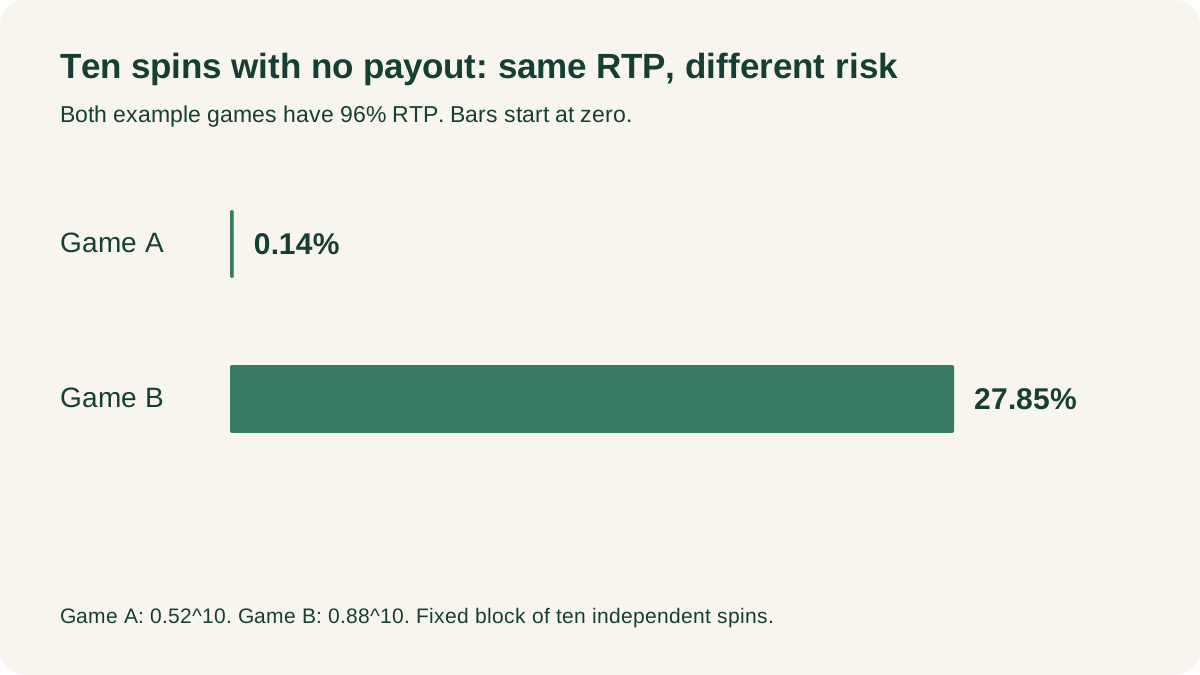
Those figures apply to the next fixed block of ten spins, not the chance of finding a dry spell anywhere in a longer session. After an empty spin, the next spin's chance does not improve. The regulator confirms that previous results do not change the winning chance on a random machine.
Check what the game counts as a hit
For this comparison, a hit means any positive payout. In a real game's statistics, check the definition. A $0.20 return on a $1 spin can count as a hit while still leaving you $0.80 behind.
Read the exact game's help screen for its RTP setting, paytable and feature rules. Our Wild Casino review covers the operator; it cannot establish the payout pattern of every game in its lobby.
Our calculation assumes fixed $1 stakes, independent spins, no bonus rounds and only one possible positive payout in each model. Game A returns 0.48 × $2 = $0.96 per $1 stake. Game B returns 0.12 × $8 = $0.96. Expected loss is $100 × 4% = $4.
Real slots have more outcomes. Hit frequency alone cannot tell you your chance of finishing ahead. That requires the full payout distribution and the number of spins played.
Calculation and source checked September 20, 2026. Published September 20, 2026. Updated September 20, 2026.

Emily Chen
Blockchain Casino Analyst · 6 years
Emily reviews how crypto casinos use blockchain systems in practice. She checks provably fair tools, wallet flows, game records, and the gap between a technical claim and what a player can actually verify. Her comparison work is built around repeatable checks rather than casino marketing copy. Away from the screen, she collects mechanical keyboards and is still looking for a quiet switch she genuinely likes.
Read next
No-Commission Baccarat vs 5% Commission: The $40 Difference
Compare standard Banker commission with Super 6 no-commission baccarat, including house edge, $10,000 expected loss and the rule to check.
8 min read
What 96% Slot RTP Means After 500 Spins
Calculate the expected loss for 500 slot spins at 96% RTP, see why one session can finish far from 96%, and learn which game details to check first.
8 min read