
Dealer hits soft 17: about $2.20 extra per $1,000 bet
Compare H17 and S17 blackjack with a simple dollar model. See the added expected loss at $5, $10 and $25 bets while all other rules stay the same.
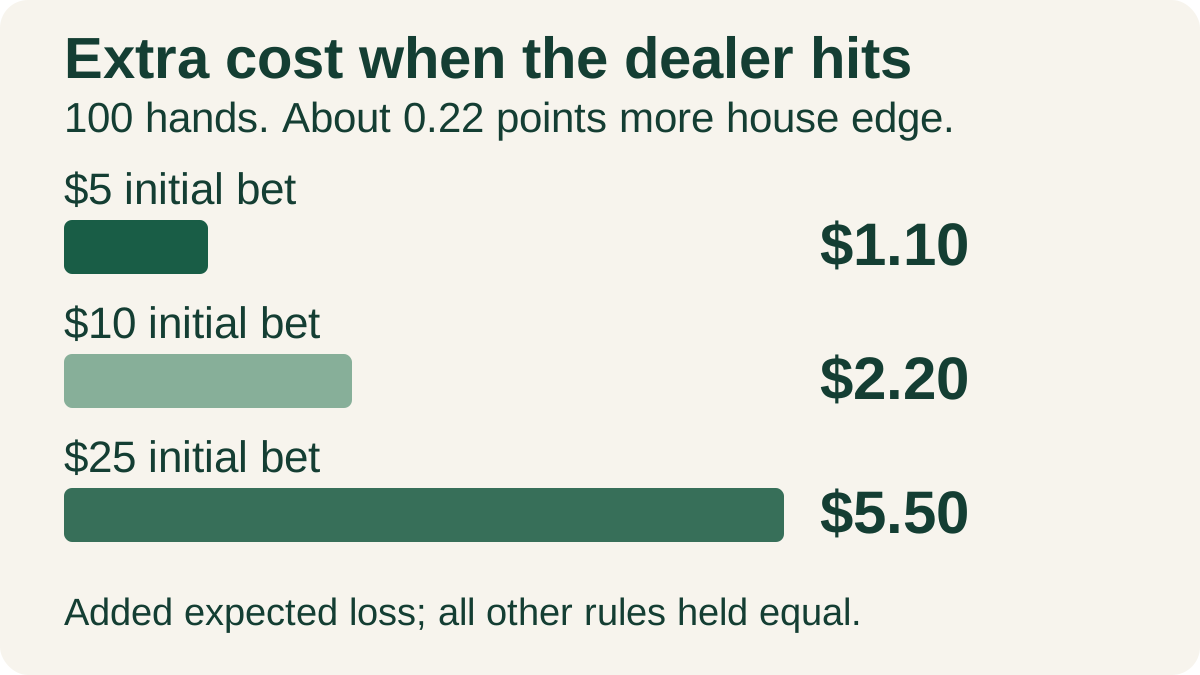
When a blackjack dealer hits soft 17, the added expected loss is about $2.20 per $1,000 in initial bets, compared with an otherwise identical stand-on-soft-17 game. That uses the 0.22 percentage-point rule effect published by Wizard of Odds.
For example, 100 hands starting with a $10 bet total $1,000. The soft-17 rule adds about $2.20 to their expected cost. It does not mean your total expected loss is $2.20 or predict your result over those hands.
Price the soft-17 rule at your bet size
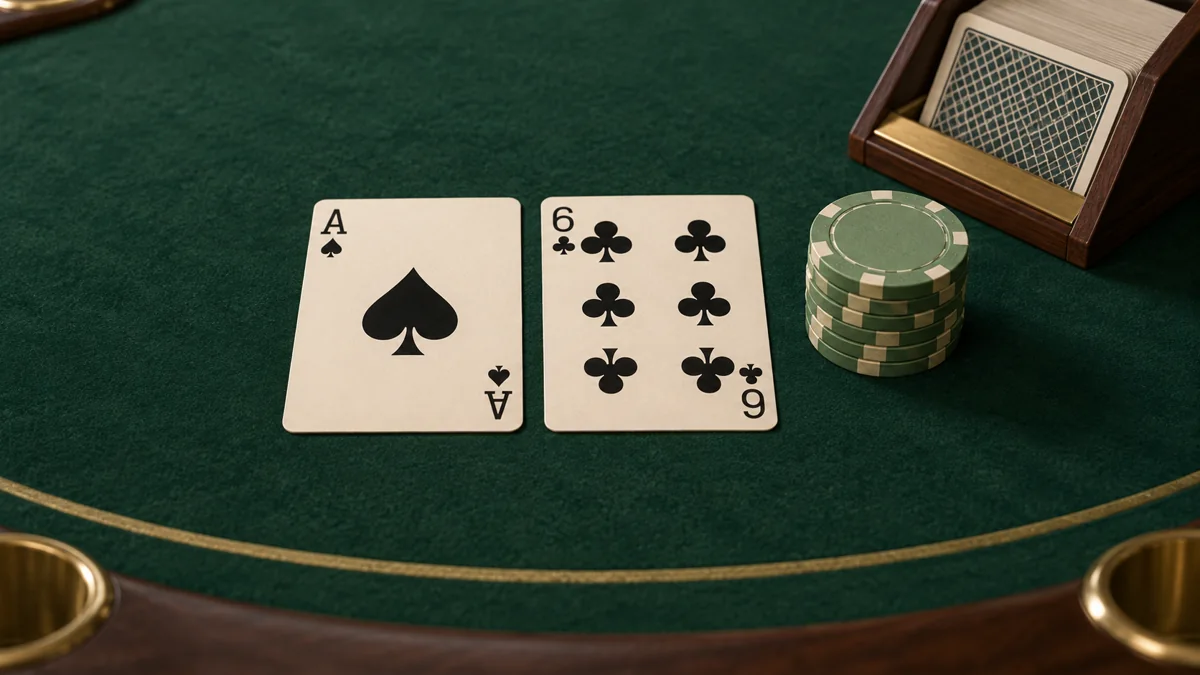
Soft 17 includes an ace counted as 11, such as ace-six. At an H17 table, the dealer must draw on that total. At an S17 table, the dealer stands. This rule describes the dealer's action; your own ace-six hand needs a separate strategy decision.
For our comparison, keep the number of hands and initial bet the same. Multiply their total by 0.0022 to estimate the extra cost of H17.
| Initial bet | Hands | Extra cost |
|---|---|---|
| $5 | 100 | $1.10 |
| $10 | 100 | $2.20 |
| $25 | 100 | $5.50 |
| $10 | 500 | $11.00 |
These figures compare the two rules across many repetitions of the same conditions. Any single session can finish far above or below that average. A $2.20 rule difference is not a $2.20 spending limit.
Compare the full rules before choosing a table
The cited 0.22-point estimate assumes eight decks, doubling on any first two cards, doubling after splitting and splitting to four hands. It includes the proper basic-strategy changes for each dealer rule. It is an approximate rule effect, not an exact edge for every blackjack game.
Use the blackjack basic strategy calculator to select H17 or S17 for its stated shoe-game profile. It shows playing actions and a chart. It does not calculate the exact house edge or model surrender and no-hole-card rules.
Check the blackjack payout separately. Our 6:5 versus 3:2 comparison prices that different rule. Choosing S17 alone does not establish which of two tables costs less when their payouts or other rules differ.
For your own estimate, count hands rather than assume a fixed hourly speed. At $10 for 60 hands, the same calculation gives $600 × 0.0022 = $1.32 extra. At 120 hands, it is $2.64.
Calculation: added expected loss = initial bet × hands × 0.0022. Use starting wagers in this formula; do not add split and double wagers again. Assumptions exclude side bets, rewards and strategy errors. For a full game estimate, enter every rule in the Wizard of Odds house-edge calculator.
Sources and calculation checked September 23, 2026. Published September 23, 2026. Updated September 23, 2026.

Emily Chen
Blockchain Casino Analyst · 6 years
Emily reviews how crypto casinos use blockchain systems in practice. She checks provably fair tools, wallet flows, game records, and the gap between a technical claim and what a player can actually verify. Her comparison work is built around repeatable checks rather than casino marketing copy. Away from the screen, she collects mechanical keyboards and is still looking for a quiet switch she genuinely likes.
Read next
No-Commission Baccarat vs 5% Commission: The $40 Difference
Compare standard Banker commission with Super 6 no-commission baccarat, including house edge, $10,000 expected loss and the rule to check.
8 min read
Roulette first-five bet: same numbers, $2 less on a win
A $10 first-five roulette bet pays $60 profit. Five $2 straight bets on the same numbers pay $62 profit. Compare the odds and expected cost.
3 min read
Slot hit frequency vs RTP: more hits, same $4 cost
Two example slots return 96% while paying on 48% and 12% of spins. See why more frequent hits do not mean a better return or a guaranteed session result.
3 min read