
6:5 vs 3:2 Blackjack: Expected Loss per Hour
Compare 6:5 and 3:2 blackjack payouts with a worked hourly-loss formula, table-rule checks, and examples for common bet sizes.
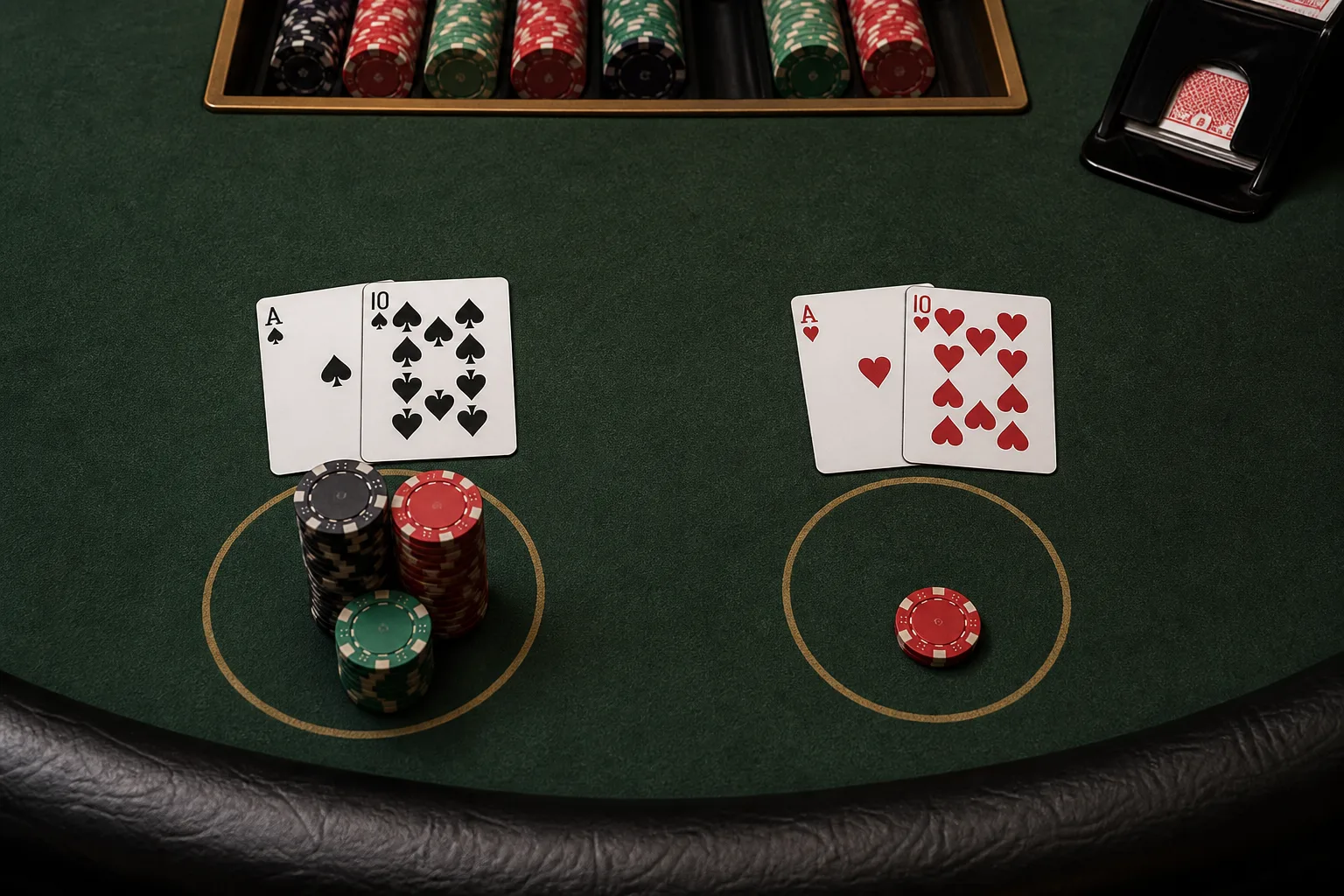
A 6:5 blackjack table pays $12 profit on a $10 natural. A 3:2 table pays $15. That $3 gap applies only when you make a winning natural blackjack, but it adds a large cost over a full session.
Michael Shackleford's Wizard of Odds calculation puts the extra house edge at 1.36 percentage points when all other rules are equal. In his six-deck example, the house edge rises from 0.46% at 3:2 to 1.82% at 6:5.
How a 30-cent payout gap adds 1.36% to the house edge
A natural pays 1.5 units at 3:2 and 1.2 units at 6:5. The payout difference is 0.3 units for every unit bet.
Wizard of Odds calculates the chance of a winning player blackjack at about 4.53%. A dealer blackjack pushes, so the calculation removes those hands.
Extra house edge = 4.53% × (1.5 - 1.2) = 1.359%
Rounded to two decimal places, 6:5 adds 1.36% to the house edge. This cost comes from the payout rule alone. It does not depend on whether you win or lose the next hand.
Expected loss at 72 hands per hour
The hourly estimate uses one direct formula:
Expected loss per hour = average bet × house edge × hands per hour
The table uses the Wizard of Odds example edges and 72 hands per hour. Real game speed varies with the number of players, dealer pace, side bets and player decisions.
| Average bet | 3:2 at 0.46% | 6:5 at 1.82% | Extra expected loss at 6:5 |
|---|---|---|---|
| $5 | $1.66 | $6.55 | $4.90 |
| $10 | $3.31 | $13.10 | $9.79 |
| $15 | $4.97 | $19.66 | $14.69 |
| $25 | $8.28 | $32.76 | $24.48 |
| $50 | $16.56 | $65.52 | $48.96 |
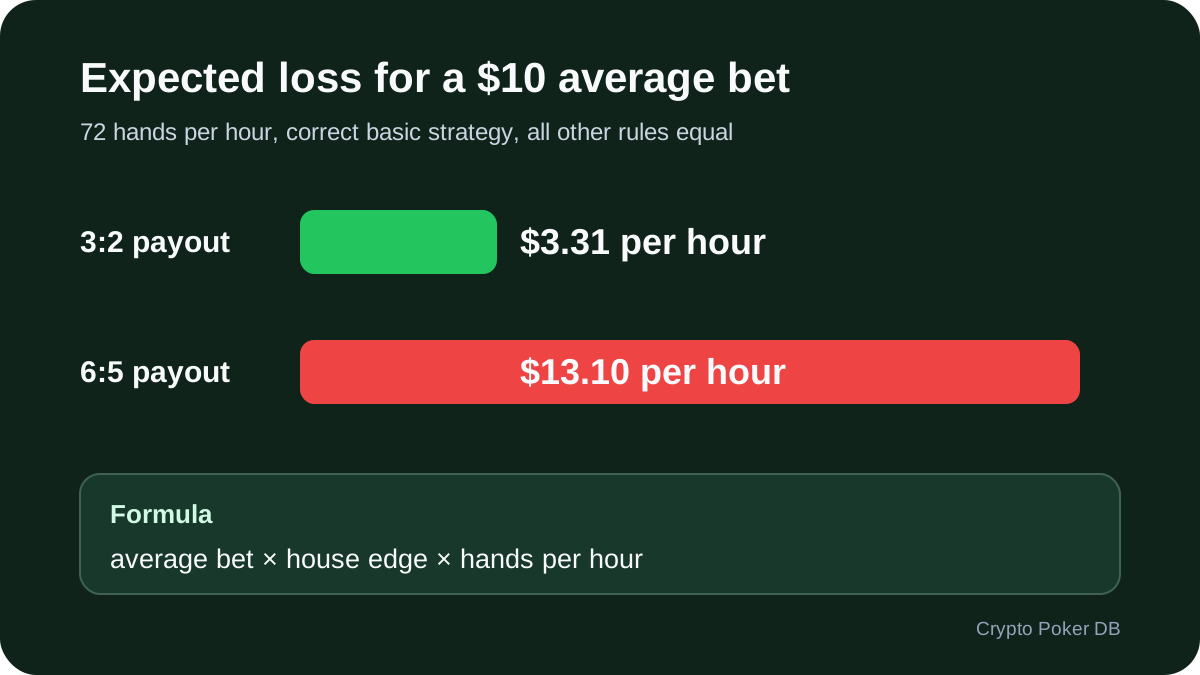
These are long-run averages, not session forecasts. A player can finish one hour well ahead or far behind either figure.
A $15 bet at 6:5 can cost more than a $50 bet at 3:2
Low table limits can make 6:5 look cheaper. The expected-loss calculation can reverse that first impression.
At 72 hands per hour, a $15 average bet at 6:5 has an expected loss of:
$15 × 1.82% × 72 = $19.66 per hour
A $50 average bet at 3:2 has an expected loss of:
$50 × 0.46% × 72 = $16.56 per hour
Under these assumptions, the $15 table costs $3.10 more per hour in expected value. You must also allow for bankroll swings. A lower expected loss does not make a $50 minimum safe for a small bankroll.
The exact break-even average bet is $59.35 at 3:2:
$15 × 1.82% ÷ 0.46% = $59.35
This means a $15 6:5 table and a $59.35 3:2 table have the same expected loss per hand when every other rule is equal.
Check five table rules before you buy in
The blackjack payout is the first rule to read, but it is not the only rule that changes the cost of a game.
| Table rule | What to check | Why it changes your calculation |
|---|---|---|
| Blackjack payout | 3:2 or 6:5 | Changes the return on a winning natural |
| Dealer soft 17 | S17 or H17 | Changes the house edge and some basic-strategy actions |
| Number of decks | Single, double or shoe | Changes card probabilities and strategy |
| Double after split | Allowed or not allowed | Changes the value of some pair splits |
| Surrender | Available or unavailable | Changes the best action for some weak hands |
Our soft-17 cost comparison shows the added expected loss when the dealer hits soft 17, with all other rules held equal.
Use our blackjack basic strategy calculator to match S17 or H17 and double-after-split rules to the action chart. The tool displays a payout reminder, but it does not calculate the house edge. For a full rule-based edge estimate, use the Wizard of Odds blackjack house edge calculator.
Change the three inputs to price your table
Replace the average bet, house edge and hands per hour with values for the table you plan to play.
For example, a $20 game with a 0.70% house edge at 55 hands per hour gives:
$20 × 0.70% × 55 = $7.70 expected loss per hour
The house edge must match the full rule set and correct basic strategy. Do not copy the 0.46% example onto a table with different decks, surrender rules or dealer actions.
A recent r/blackjack discussion about 6:5 and table minimums shows that players still compare a low minimum with a better payout. The comments are anecdotal. The calculation above is the part you can verify.
What this hourly figure cannot tell you
Expected loss does not predict the result of one visit. Blackjack has high short-run variance, and doubles and splits change the money at risk after the first bet.
The formula also assumes correct basic strategy. Strategy errors increase the effective cost. Card counting, promotions, side bets, comps and unusual table rules need separate calculations.
Before you play, record the payout, copy the table rules, estimate the pace and calculate the hourly cost. If 6:5 is the only game within your bankroll limit, the lower-cost choice may be to skip that table.
Gambling involves financial risk. Set a fixed loss limit before play and never use money needed for rent, bills or debt payments.
Sources for the payout and house-edge calculation
- Wizard of Odds: 3 to 2 opposed to 6 to 5 blackjack, updated August 3, 2026.
- Wizard of Odds: blackjack house edge calculator, checked September 3, 2026.
For a different rule, our $20 late-surrender example compares the cost of giving up half the bet with hitting 16 against a dealer 10.

Yuki Tanaka
Live Casino Reviewer · 7 years
Yuki compares live dealer lobbies with an eye on table limits, provider coverage, mobile stability, and the small interface choices that decide whether a session feels smooth or irritating. She also reviews blackjack, roulette, baccarat, and game-show tables. She keeps handwritten tasting notes for coffee, although the margins usually end up full of table-limit calculations.