
Blackjack surrender: saving 80 cents on a bad $20 hand
With 16 against a dealer 10, late surrender can lose less than hitting. Our $20 example compares the cost and explains when the rule applies.
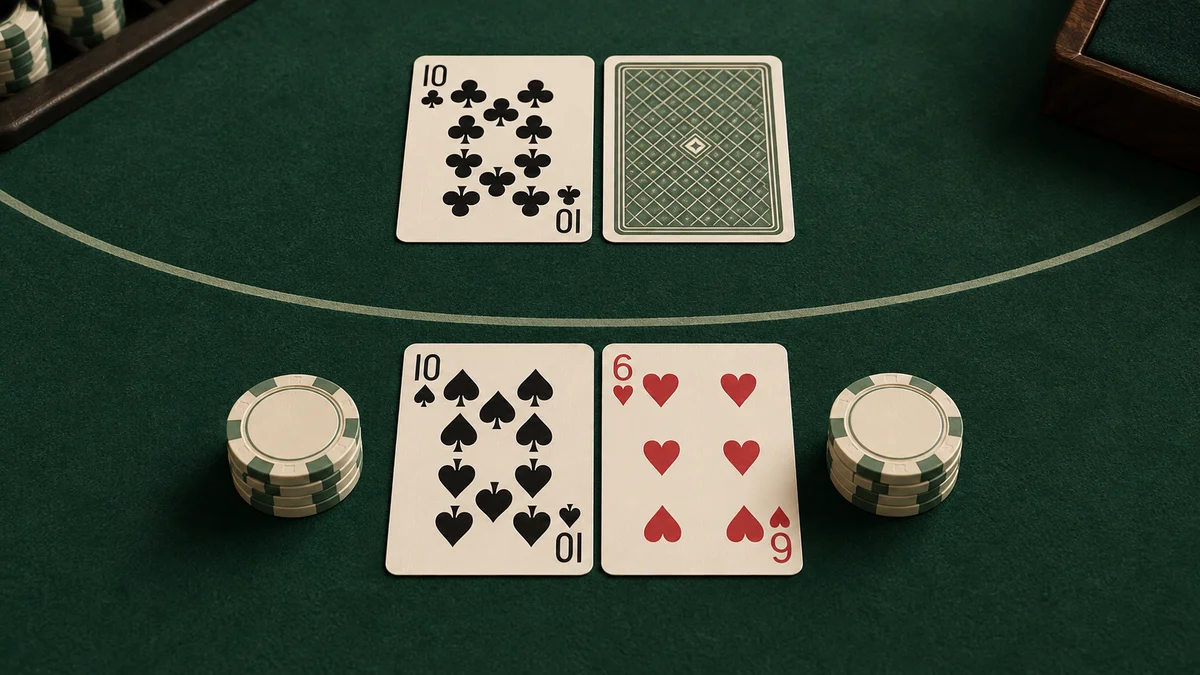
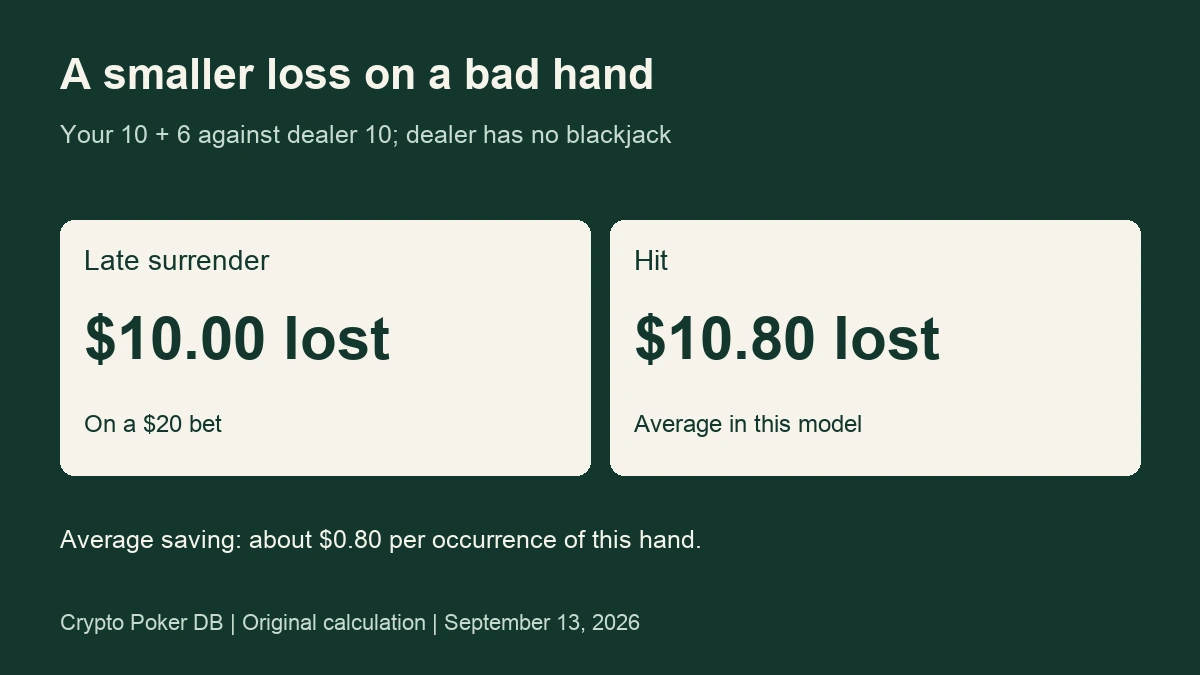
Late surrender can save about 80 cents on a $20 blackjack hand when you have 16 against a dealer 10. You still lose money on the hand. The saving comes from accepting a smaller loss.
Our example uses a 10 and a 6 in your hand. The dealer has already checked and does not have blackjack. Surrender is available before you take another card.
What happens to the $20 bet
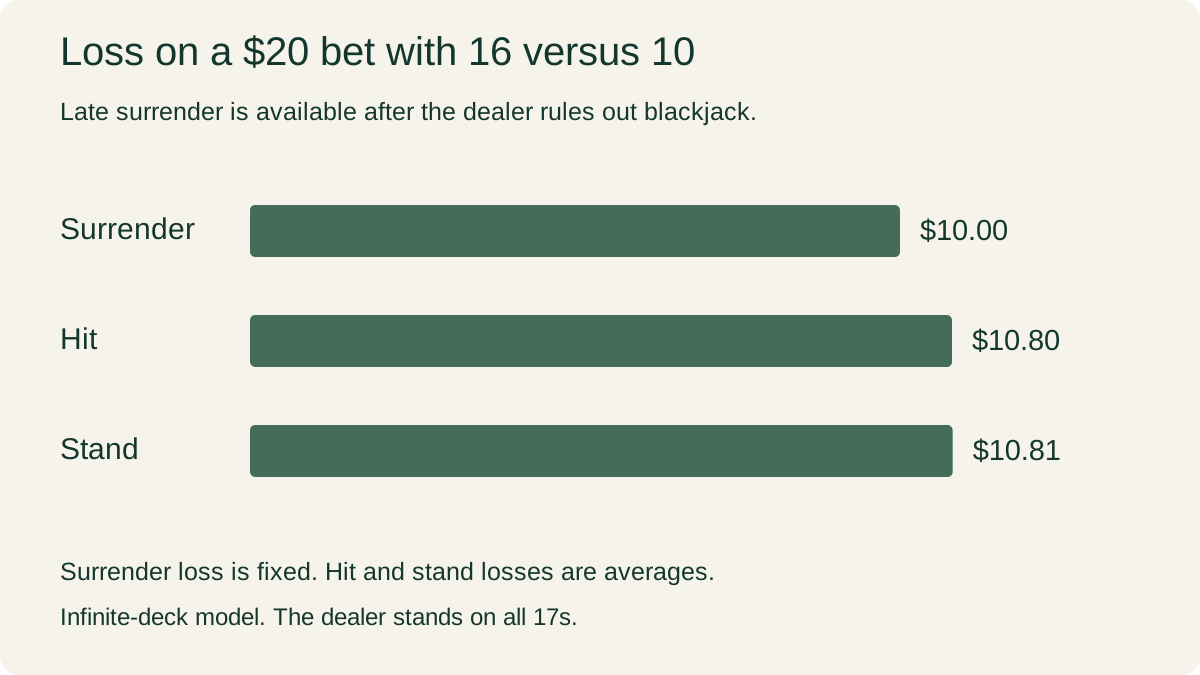
- Surrender returns $10 and ends the hand. You lose the other $10.
- Hitting loses about $10.80 on average in our model.
- Standing loses about $10.81 on average.
An average includes wins, losses, and ties across many repeats of this exact situation. You will not lose exactly $10.80 when you choose to hit once.
Why giving up half can cost less
A 16 has little room to improve. An ace through a five keeps you at 21 or below. A six through a ten-value card makes you go over 21 and lose immediately.
Standing avoids that immediate loss, but leaves you waiting for the dealer to go over 21. Neither choice performs well against a dealer 10.
| Choice | Loss on a $20 bet |
|---|---|
| Surrender | $10.00, fixed |
| Hit | $10.80, average |
| Stand | $10.81, average |
The average saving from surrender is about $8 across ten repeats of this situation compared with hitting. That does not mean it saves $8 in every ten hands dealt. Most hands are different.
Check that late surrender is available
The Wizard of Odds surrender rules distinguish late surrender from early surrender. Late surrender applies after the dealer checks for blackjack. Early surrender is a different rule with different decisions.
Check the game's help panel before playing. Do not apply this example to a pair of eights, which has a separate split decision. Other totals, dealer cards, and rules need their own strategy.
Our blackjack strategy calculator covers a multi-deck game without surrender. Use it for that rule set. For a surrender game, use a chart that explicitly includes surrender and matches the table's rules.
How we calculated the 80-cent saving
We used a model where card probabilities stay fixed on every draw. This is often called an infinite-deck model. The dealer stands on all 17s, and the calculation starts after blackjack has been ruled out.
We counted the possible dealer finishes and each possible card you can draw on 16. The results match the Wizard of Odds return table: hitting loses about 54 cents per dollar bet. At $20, that is about $10.80, compared with $10 for surrender.
A finite shoe can give slightly different figures. This is a comparison for one hand, not the house edge for the whole game. It cannot be used as a bonus wagering cost or a forecast of your session loss.

Yuki Tanaka
Live Casino Reviewer · 7 years
Yuki compares live dealer lobbies with an eye on table limits, provider coverage, mobile stability, and the small interface choices that decide whether a session feels smooth or irritating. She also reviews blackjack, roulette, baccarat, and game-show tables. She keeps handwritten tasting notes for coffee, although the margins usually end up full of table-limit calculations.
Read next
Baccarat tie bets: 8 to 1 versus 9 to 1 in 20 hands
Compare baccarat tie bet payouts with exact eight-deck odds. Our 20-hand model shows how 9 to 1 changes expected loss and break-even results.
5 min read
10% bonus contribution: why $2,000 becomes $20,000
Only 10% of a bet may count toward a casino bonus. Our $100 example shows how a lower game edge can still produce a higher wagering cost.
3 min read
Craps odds bets: a lower house edge does not mean less lost
Adding odds to a $15 pass-line bet lowers the house-edge percentage, but the average dollar loss stays the same. See the result in one simple example.
3 min read