
Baccarat tie bets: 8 to 1 versus 9 to 1 in 20 hands
Compare baccarat tie bet payouts with exact eight-deck odds. Our 20-hand model shows how 9 to 1 changes expected loss and break-even results.
Published September 8, 2026. Updated September 12, 2026.
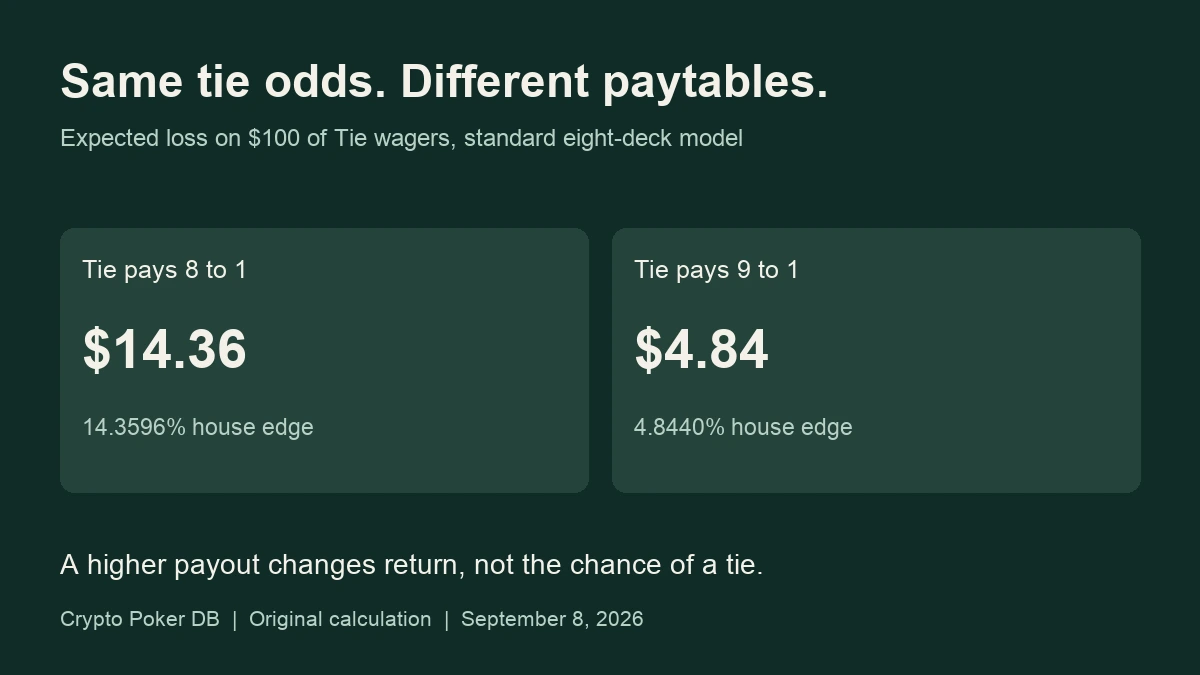
A baccarat Tie bet paying 9 to 1 has a lower house edge than one paying 8 to 1 under the same standard eight-deck rules. The calculated edges are 4.8440% and 14.3596%. On $100 of total Tie wagers, that is about $4.84 versus $14.36 in expected loss.
We also calculated a short-session result that the house-edge figure does not show. In a model of twenty independently reset hands, two ties leave a $5-per-hand bettor down $10 at 8 to 1 but exactly even at 9 to 1. Three ties are needed for a profit at either payout.
This is a comparison of two ordinary Tie paytables, not a claim about a named casino's current game. The deck count, drawing rules, and the distinction between net winnings and total returns must stay the same for the comparison to hold.
A tie occurs about 9.5156% of the time in the eight-deck model
Wizard of Odds' eight-deck analysis counts 475,627,426,473,216 tie outcomes out of 4,998,398,275,503,360 total outcomes. Their ratio gives p = 0.095155968.... We use the full fraction for the calculations and round displayed results afterward.
An 8-to-1 win gives $8 profit plus the $1 stake back. A loss costs $1. The expected net result for one $1 bet is therefore 8p - (1 - p) = 9p - 1, or about -$0.143596. At 9 to 1, the result is 10p - 1, about -$0.048440.
The extra unit paid on a win adds p, or about 9.5156 cents per dollar wagered, to expected return. It does not change the frequency of ties. Wizard of Odds also checks the 9-to-1 comparison in its baccarat questions.
A similar payout-only comparison appears in our video poker royal-bonus draw: the same replacement cards can have different value under two coin settings.
Neither payout reaches the fair net odds of roughly 9.5091 to 1, calculated as (1 - p) / p. Higher payouts reduce the disadvantage; they do not make these two bets positive-expectation wagers under the stated model.
Two ties recover twenty $5 stakes only at 9 to 1
Set aside a fixed total of $100 for twenty $5 Tie bets. The model makes every hand a fresh, independent draw from the same eight-deck distribution. It has no bet progression, bonus, cashback, stop rule, or extra side bet.
If K of the twenty bets win, net profit is $5 × (9K - 20) at 8 to 1. At 9 to 1 it is $5 × (10K - 20). The multiplier includes the returned winning stake, because all twenty stakes were deducted in the total.
| Ties in twenty bets | Net result at 8 to 1 | Net result at 9 to 1 |
|---|---|---|
| 0 | -$100 | -$100 |
| 1 | -$55 | -$50 |
| 2 | -$10 | $0 |
| 3 | +$35 | +$50 |
| 4 | +$80 | +$100 |
For this specific twenty-bet schedule, both paytables require at least three ties to finish ahead. The better payout increases the amount won on those profitable sessions and turns the two-tie outcome from a small loss into a break-even result.
The expected losses remain $14.36 and $4.84 because expectation averages all possible outcomes. Neither number is a typical bill that the casino deducts from the $100. You can lose every bet or finish with a profit.
The model has a 29.55% chance of profit at either payout
With fixed probability p and independent hands, the number of ties has a binomial distribution. For exactly k ties, the probability is C(20,k) × p^k × (1-p)^(20-k). The NIST binomial reference gives the distribution formula and its assumptions.
Our calculation gives a 28.44% chance of exactly two ties and a 29.55% chance of three or more. At 8 to 1, the two-tie result is still a loss. At 9 to 1, it is a push for the session, so the chance of finishing at least even rises to 58.00%.
| Twenty-bet result | Tie pays 8 to 1 | Tie pays 9 to 1 |
|---|---|---|
| Loss | 70.45% | 42.00% |
| Exactly even | 0.00% | 28.44% |
| Profit | 29.55% | 29.55% |
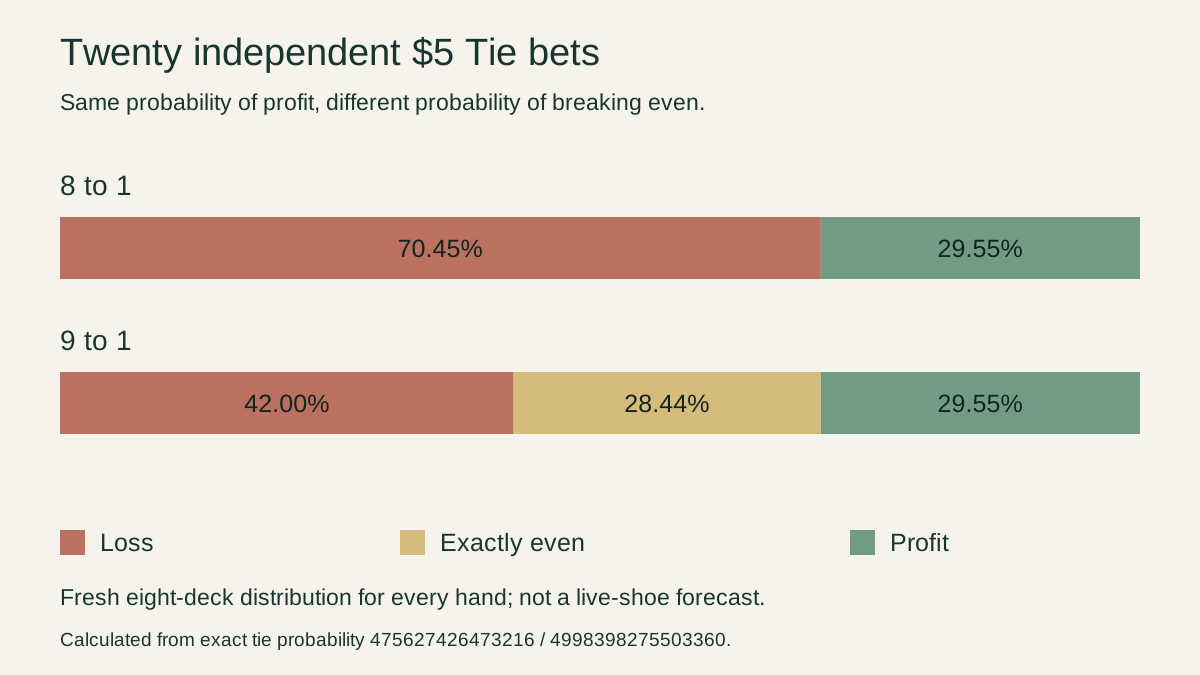
Displayed percentages are rounded. The exact categories sum to 100% for each paytable.
A continuous live-dealer shoe does not reset after every hand. Its remaining card composition changes, so this binomial calculation is not an exact live-shoe forecast. It is a controlled model that keeps deal probability constant while changing only the payout. A road display alone does not supply the remaining card counts needed for a shoe-specific calculation.
Read the Tie payout separately from the Banker commission
The Tie wager has its own paytable. A casino can advertise commission-free Banker bets while leaving the Tie payout unchanged. Our Banker commission comparison examines that separate wager; those Banker rules do not determine the Tie return.
For an online table, open the exact game's help panel. Confirm the number of decks and whether “9” means nine units of profit or nine units returned in total. Nine returned for one staked is the same return as an 8-to-1 net payout. Multiplier and exact-total Tie variants need their own probability analysis.
Use the Meta Win casino review to check operator and cashier details, then read the selected game's rules. The review does not confirm that a particular Tie paytable is available to you. Set your total wagering limit before play; changing the stake after a loss does not improve the payout schedule.
Sources: Wizard of Odds' eight-deck outcome counts, its 9-to-1 Tie analysis, and NIST's binomial distribution. The twenty-bet distribution and figures are original calculations from the stated independent-hand model.

Yuki Tanaka
Live Casino Reviewer · 7 years
Yuki compares live dealer lobbies with an eye on table limits, provider coverage, mobile stability, and the small interface choices that decide whether a session feels smooth or irritating. She also reviews blackjack, roulette, baccarat, and game-show tables. She keeps handwritten tasting notes for coffee, although the margins usually end up full of table-limit calculations.
Read next
Blackjack surrender: saving 80 cents on a bad $20 hand
With 16 against a dealer 10, late surrender can lose less than hitting. Our $20 example compares the cost and explains when the rule applies.
3 min read
10% bonus contribution: why $2,000 becomes $20,000
Only 10% of a bet may count toward a casino bonus. Our $100 example shows how a lower game edge can still produce a higher wagering cost.
3 min read
Craps field bet: triple 12 halves the expected loss
On $10 craps field bets, paying 3:1 instead of 2:1 on twelve cuts expected loss from $20 to $10 over 36 rolls. See the payout comparison.
3 min read