
10% bonus contribution: why $2,000 becomes $20,000
Only 10% of a bet may count toward a casino bonus. Our $100 example shows how a lower game edge can still produce a higher wagering cost.

If a game contributes 10% toward a bonus, a $10 bet clears only $1 of the requirement. Clearing $2,000 of required wagering therefore needs $20,000 in bets on that game.
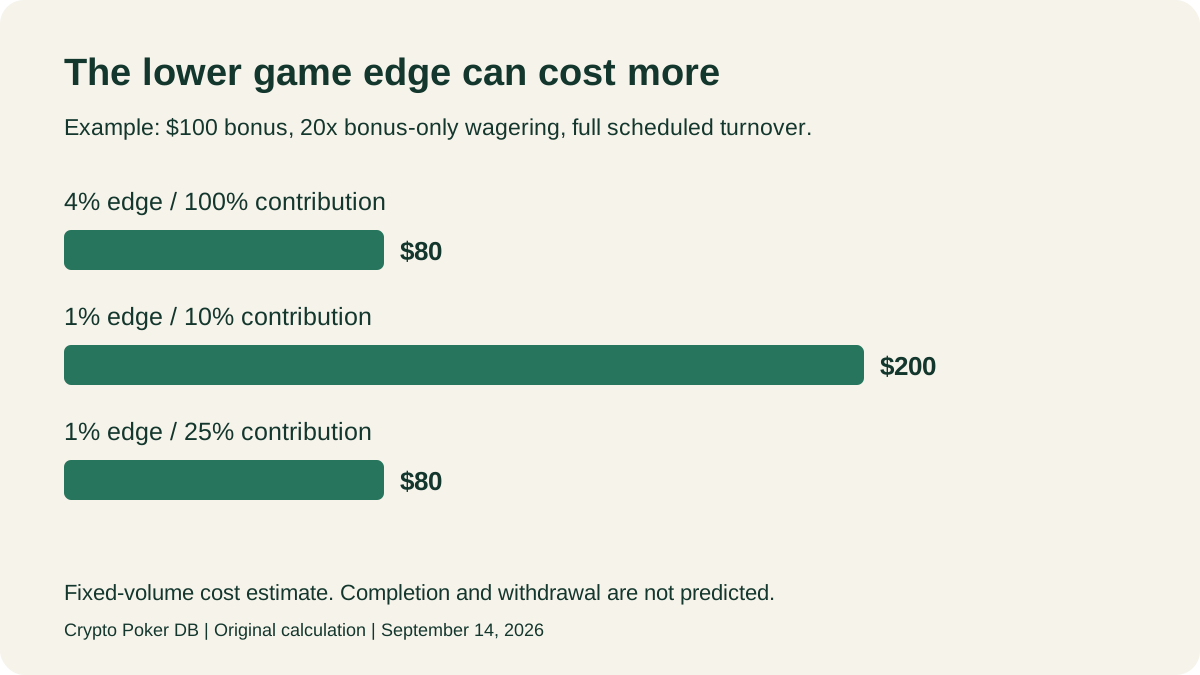
Our $100 bonus example gives an estimated wagering cost of $200 on a 1% house-edge game with 10% contribution. A 4% house-edge game with full contribution costs $80 for the same requirement.
Compare the amount you must bet
Assume a bonus requires 20 times the $100 bonus credit. The deposit is excluded, so the target is $2,000 of qualifying wagering. These are example terms, not a named casino's offer.
"Contribution" means the share of each stake that counts toward that target. Wizard of Odds explains this rule in its casino bonus terms analysis. A 10% contribution does not mean that the casino refunds 10% of losses.
| Example game | House edge | Contribution | Total bets needed | Estimated cost |
|---|---|---|---|---|
| A | 4% | 100% | $2,000 | $80 |
| B | 1% | 10% | $20,000 | $200 |
| C | 1% | 25% | $8,000 | $80 |
Game B needs ten times as much betting as A. Its lower edge does not offset that extra volume. Game C shows the dividing point: a 1% edge at 25% contribution has the same estimated cost as a 4% edge at full contribution.
Check the actual bonus before accepting it
Use the bonus value calculator with the exact contribution and game RTP. RTP is the theoretical return; a 99% RTP corresponds to a 1% house edge in this calculation.
First check whether the multiplier applies to the bonus alone or to deposit plus bonus. If a $100 deposit is also included in our example, the target doubles to $4,000. Each turnover and cost figure in the table then doubles too.
Also check excluded games, maximum bets, expiry, and withdrawal limits. A game with 0% contribution cannot clear the requirement. The 1win bonus terms page separates its listed offer from conditions you still need to confirm. None of our example rates are verified 1win terms.
What the cost estimate leaves out
We calculated turnover as required wagering ÷ contribution, using 0.10 for 10%. Estimated cost is turnover × house edge. For Game B, that is $2,000 ÷ 0.10 × 0.01 = $200.
This is a fixed-volume estimate checked on September 14, 2026. It assumes that all the stated betting takes place at a constant edge. It does not estimate your chance of completing the bonus or your final withdrawal.
You can run out of funds before reaching the target. A positive result in the calculator does not establish that accepting the bonus is profitable for you.

Yuki Tanaka
Live Casino Reviewer · 7 years
Yuki compares live dealer lobbies with an eye on table limits, provider coverage, mobile stability, and the small interface choices that decide whether a session feels smooth or irritating. She also reviews blackjack, roulette, baccarat, and game-show tables. She keeps handwritten tasting notes for coffee, although the margins usually end up full of table-limit calculations.
Read next
Baccarat tie bets: 8 to 1 versus 9 to 1 in 20 hands
Compare baccarat tie bet payouts with exact eight-deck odds. Our 20-hand model shows how 9 to 1 changes expected loss and break-even results.
5 min read
Blackjack surrender: saving 80 cents on a bad $20 hand
With 16 against a dealer 10, late surrender can lose less than hitting. Our $20 example compares the cost and explains when the rule applies.
3 min read
Craps odds bets: a lower house edge does not mean less lost
Adding odds to a $15 pass-line bet lowers the house-edge percentage, but the average dollar loss stays the same. See the result in one simple example.
3 min read