
Craps field bet: triple 12 halves the expected loss
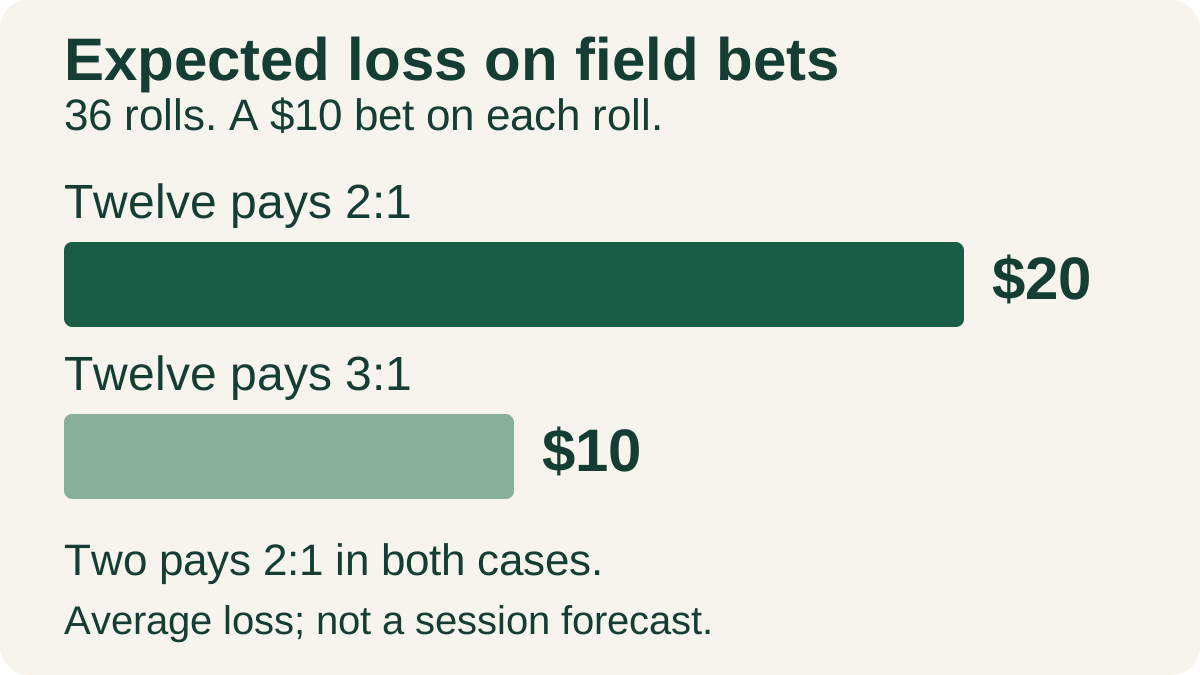
On $10 craps field bets, paying 3:1 instead of 2:1 on twelve cuts expected loss from $20 to $10 over 36 rolls. See the payout comparison.

Paying 3:1 on twelve instead of 2:1 halves the field bet's expected loss, when two still pays 2:1 and the other payouts stay the same. For a $10 field bet on each of 36 rolls, our calculation falls from $20 lost on average to $10.
The chance of a win stays the same. The change gives you an extra $10 when the dice total twelve. An expected loss is a long-run average, so a real 36-roll session can finish far above or below it.
Check the payout on two and twelve
The field wins on totals of 2, 3, 4, 9, 10, 11 or 12. The ordinary winners pay 1:1. Two and twelve have special payouts that you need to read on the table or in the game's rules. Wizard of Odds lists the field rules and both payout variants.
For a $10 stake, 2:1 means $20 profit plus your $10 stake returned. At 3:1, you receive $30 profit plus the stake. The table below compares the net profit or loss from one roll.
| Dice total | Double on 2 and 12 | Double on 2, triple on 12 |
|---|---|---|
| 2 | +$20 | +$20 |
| 12 | +$20 | +$30 |
| 3, 4, 9, 10 or 11 | +$10 | +$10 |
| 5, 6, 7 or 8 | -$10 | -$10 |
That extra payment on twelve reduces the house edge from 5.56% to 2.78%. Both versions still favor the house. Doubling your stake from $10 to $20 on the triple-paying version would bring the expected dollar loss back to $20 over 36 rolls.
The 36-outcome calculation behind the $10 difference
Two fair dice have 36 equally likely ordered outcomes. Only double six makes twelve. Two also has one outcome. The other field winners account for 14 outcomes, and losing totals account for 20.
For double payouts on both two and twelve, the net total across those outcomes is $20 + $20 + (14 × $10) - (20 × $10) = -$20. Change twelve to a $30 profit, and the total becomes -$10. Divide either total by 36 for the expected loss per bet.
Across 36 actual rolls, the model expects each ordered outcome once on average. It does not require all 36 to appear. There can be no twelves in a session, or several; previous rolls do not change the next roll's chance.
This comparison assumes a fresh $10 field bet on every roll, fair dice and no extra costs. It excludes pass-line and odds bets, which settle under different rules. Our pass-line odds comparison covers that separate bet.
If you use the bonus value calculator, enter the house edge for the exact wager and check whether the offer allows craps. A lower game edge does not override excluded-game or wagering rules.
Source and calculation checked September 22, 2026. Published September 22, 2026. Updated September 22, 2026.

Emily Chen
Blockchain Casino Analyst · 6 years
Emily reviews how crypto casinos use blockchain systems in practice. She checks provably fair tools, wallet flows, game records, and the gap between a technical claim and what a player can actually verify. Her comparison work is built around repeatable checks rather than casino marketing copy. Away from the screen, she collects mechanical keyboards and is still looking for a quiet switch she genuinely likes.
Read next
Baccarat tie bets: 8 to 1 versus 9 to 1 in 20 hands
Compare baccarat tie bet payouts with exact eight-deck odds. Our 20-hand model shows how 9 to 1 changes expected loss and break-even results.
5 min read
Blackjack surrender: saving 80 cents on a bad $20 hand
With 16 against a dealer 10, late surrender can lose less than hitting. Our $20 example compares the cost and explains when the rule applies.
3 min read
10% bonus contribution: why $2,000 becomes $20,000
Only 10% of a bet may count toward a casino bonus. Our $100 example shows how a lower game edge can still produce a higher wagering cost.
3 min read