
Double-board bomb pot odds: a $250 call for half the pot
A $500 pot and a $250 bet need 50% equity on one board when you cannot win the other. Compare exact call prices, quartered pots, and rake.
Published September 7, 2026. Updated September 7, 2026.
A hand that can win only one board needs a different price from a hand that can win the whole pot. In our $500 double-board bomb pot example, calling a $250 bet requires a 50% chance of winning the available half, before rake. A normal whole-pot calculation would show 25% required equity in the final pot.
The two figures describe the same price with different denominators. Half of 50% is 25%. The error is to compare your chance on one board with the whole-pot threshold.
A September 6 player post about a CoinPoker bomb pot shows current interest in the format. It is an anecdote about one hand, not evidence of typical profits. We built the calculation below to show what a half-pot target does to a river call.
A $250 call needs half of the available $500 share
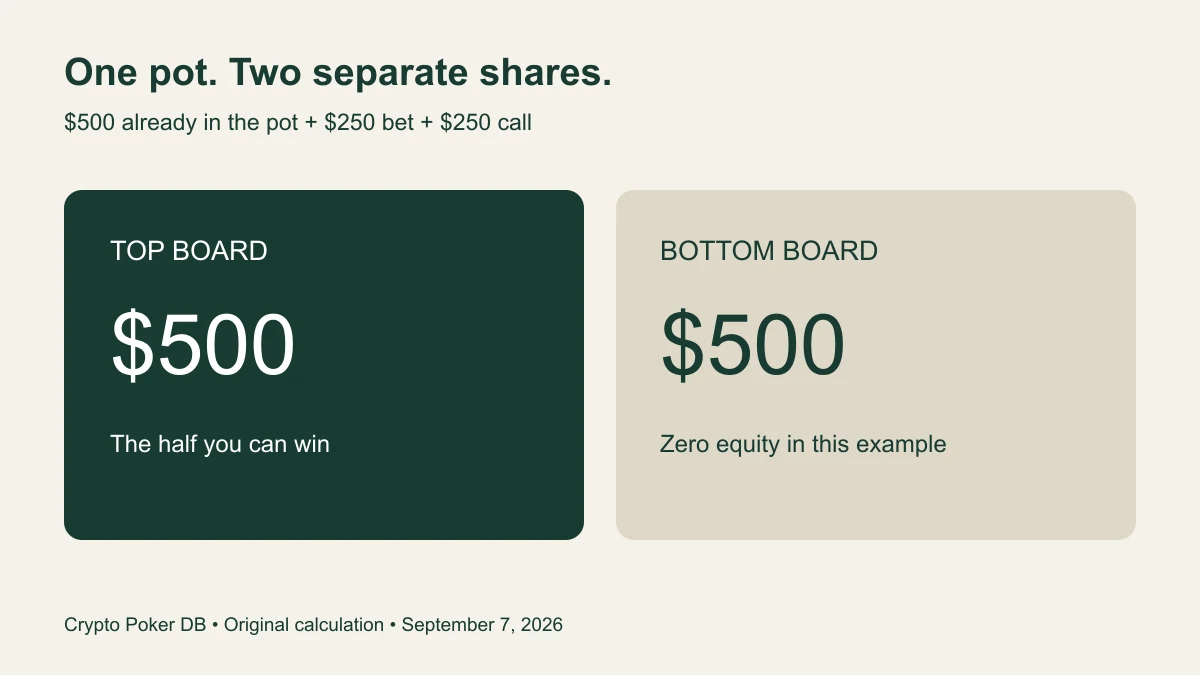
Assume $500 is in the pot before your opponent bets $250. You are heads-up on the river. Your call ends the betting, both players can win the same pot, and the final $1,000 is divided equally between two boards. There are no side pots, odd chips, ties, or rake in this first model.
Suppose you cannot win the bottom board. Let p be your chance of winning the top board outright. A win returns $500 from the final pot. A loss returns nothing. Measured from the decision to call, the expected net result is p × $500 − $250.
At p = 50%, the result is zero. At p = 65%, the call has an expected net result of $75. You still lose $250 when the top board loses. The 65% is an input to illustrate the calculation, not an equity estimate for an unspecified hand.
| Chance of winning the top board | Expected gross return | Net value of calling |
|---|---|---|
| 40% | $200 | −$50 |
| 50% | $250 | $0 |
| 65% | $325 | +$75 |
| 100% | $500 | +$250 |
Your earlier contributions are already in the pot. They do not change the comparison between folding now and calling now. A positive value for the call also does not mean the full hand, including earlier bets, made a profit.
A larger bet raises the equity needed on one board
Keep the original pot at $500 and let the opponent's bet be B. After you call B, the final pot is $500 + 2B. One board pays half that amount. The one-board break-even probability is therefore 2B / ($500 + 2B).
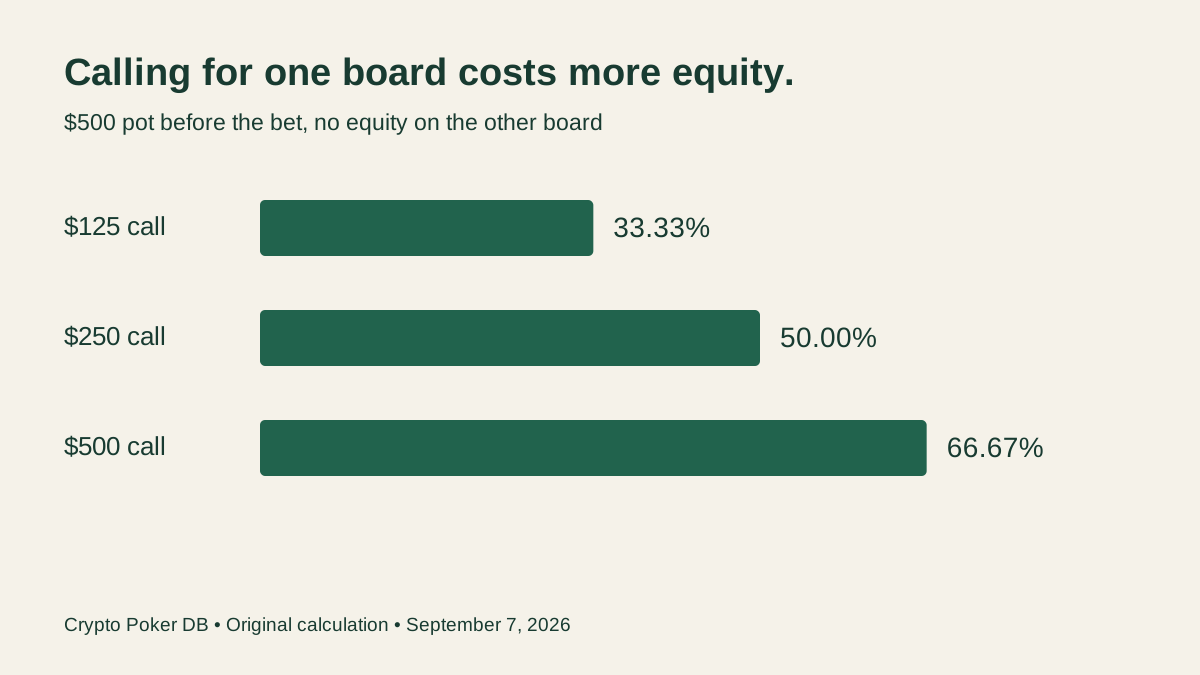
The price gets worse as the bet grows. A $125 bet needs 33.33% on the available board. A $250 bet needs 50%. A $500 bet needs 66.67%. These thresholds assume you have zero equity on the other board and that a top-board win takes its entire half.
| Opponent's bet and your call | Final pot | Available half | One-board break-even chance |
|---|---|---|---|
| $125 | $750 | $375 | 33.33% |
| $250 | $1,000 | $500 | 50.00% |
| $500 | $1,500 | $750 | 66.67% |
The pot odds calculator gives the required share of the whole final pot. For a hand that can win only one equal half, double that whole-pot percentage to express the threshold as a chance on the available board. If you also have equity on the second board, use your expected pot share across both instead.
A tied half can return less than the call costs
If you tie with one opponent on the only board you can win, you receive one quarter of the final pot. With the $250 bet, that quarter is $250. A guaranteed quarter therefore only returns your call before rake. Any chance of losing that quarter makes this particular call negative in expected value.
With a $500 bet into the original $500 pot, a guaranteed quarter is $375 from the $1,500 final pot. You pay $500 to receive $375, a $125 loss from the call decision. The size of the displayed pot does not make a quarter profitable by itself.
Rake reduces the amount available to distribute. If exactly $20 is removed from the $1,000 final pot in the first example, the available half becomes $490. The threshold rises to $250 / $490 = 51.02%. That $20 is a model assumption, not a claim about any operator's rake schedule.
These equations stop at a river decision that closes the action. Future bets, folds from other players, side pots, unequal board shares, and incomplete hand information require a different model. For a live hand, check the actual pot allocation before applying the table.
CoinPoker's official bomb pot help confirms that its format starts on the flop with player contributions and uses two boards. The half-pot distribution here is an explicit assumption of our worked example. The September 6 player post supplies discussion context only. All dollar values and thresholds above are our calculations, checked on September 7, 2026.

Maria Santos
Tournament Strategist · 6 years
Maria covers the crypto poker tournament circuit from Sunday majors to flagship series on CoinPoker and ACR. She breaks down ICM spots, final table dynamics, and satellite strategy with a clarity that appeals to beginners and seasoned MTT players alike. Her live reports from major online series have become must-reads. Trains for marathons between tournament sessions, having completed six so far.