
Run it twice odds: the exact result of a nine-out river draw
An exact 44-card model shows how running it twice changes the chance of losing a $1,000 pot, while keeping the same $204.55 average return.
Published September 6, 2026. Updated September 6, 2026.
Running it twice can reduce the chance of losing the entire pot. It does not increase your share of the pot on average when the cards, rake and payout rules stay the same.
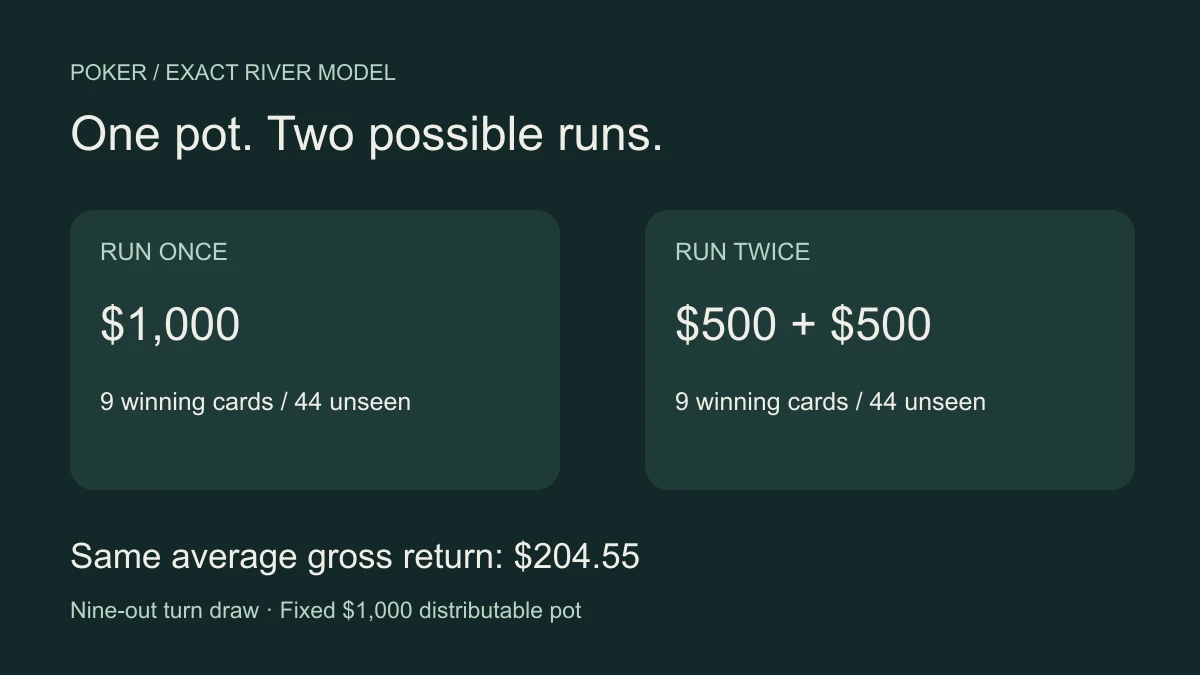
In the river model below, a nine-out draw wins a single run 20.45% of the time. With two runs, it collects at least half the pot 37.10% of the time. Its average gross return from a $1,000 pot remains $204.55.
A September 5 reply to a Lodge Poker Club post welcomed a hand being run twice. That is a current player preference, not evidence that two runs improve expected value. We calculated the full distribution to separate the chance of collecting something from the amount collected.
Nine winning cards remain in this specific turn hand
You hold K♥ J♥ against A♣ A♦. The board is Q♥ 7♥ 2♣ 3♠, and both players are all-in. There is one river left to deal. The eight known cards leave 44 unseen cards.
Nine of those cards are hearts. Each gives you a flush that beats the aces. Every non-heart loses: a king or jack gives you only one pair, and no river makes you a straight. There are no tied outcomes in this hand.
Assume a $1,000 pot available for distribution, after any unchanged rake. There are no side pots or cash-out charges. We do not condition on unknown folded cards or burn cards; the river positions are random among the 44 unseen cards.
With one run, you collect $1,000 with probability 9/44 and $0 with probability 35/44. The $204.55 average includes returned money already in the pot. It is not a $204.55 profit forecast. Subtract your total contribution to calculate net profit.
Two river cards produce three possible payouts
For two runs, split the pot into two $500 shares. Deal two river cards from the same deck without replacing the first card. PokerStars' published rules confirm that each board receives a separate part of the pot. The exact card model here assumes two distinct river cards.
There are 44 × 43 = 1,892 equally likely ordered river pairs. Winning both requires two hearts, giving 9 × 8 = 72 pairs. Losing both requires two non-hearts, giving 35 × 34 = 1,190 pairs.
Winning exactly once can occur in either order. That gives 2 × 9 × 35 = 630 pairs. These three counts add to 1,892.
| Gross pot return | One run | Two runs |
|---|---|---|
| $0 | 79.55% | 62.90% |
| $500 | 0.00% | 33.30% |
| $1,000 | 20.45% | 3.81% |
| Average return | $204.55 | $204.55 |
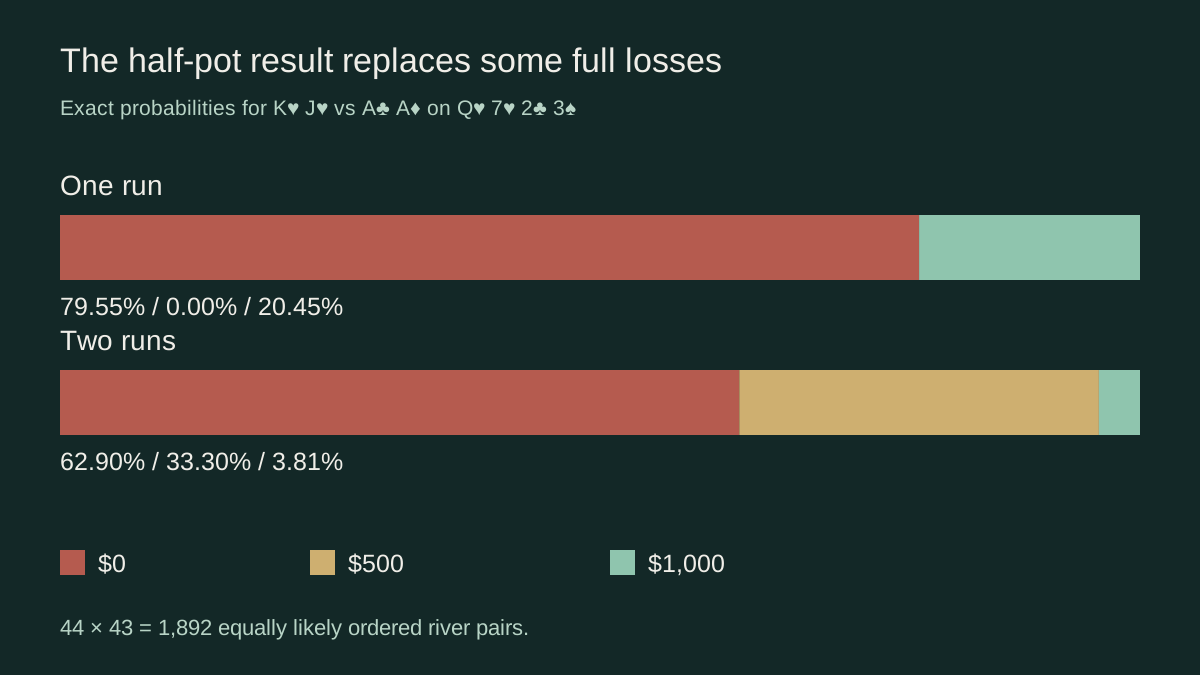
The rounded percentages can sum to 100.01%. The exact fractions sum to 100%.
For two runs, the average is (72 × $1,000 + 630 × $500) / 1,892 = $204.55. The chance of collecting something rises because many full losses become half-pot returns. The chance of collecting the whole pot also falls sharply.
The second river depends on the first card
Two runs are often approximated as independent trials. That approximation would put the chance of winning both at (9/44)² = 4.18%. The exact result here is 3.81% because a heart on the first run leaves eight hearts among 43 cards.
After a winning first river, the second river wins with probability 8/43, or 18.60%. After a losing first river, it wins with probability 9/43, or 20.93%. Before either card is seen, each river position still has the same 9/44 marginal chance to win.
The payout standard deviation falls from $403.37 for one run to $281.89 for two. We calculated the first as 1,000 × sqrt(p × (1-p)), where p = 9/44. For two draws without replacement, payout variance is the one-run variance multiplied by 42/86. That is a 51.16% variance reduction in this particular one-card model.
Use the poker equity calculator to examine the preflop matchup. This article adds the exact payout calculation for the stated turn hand. Different boards, tied hands, side pots and earlier all-ins require different outcome counts.
An extra fee changes the equal-value comparison
PokerStars says it charges no additional rake for Run It Twice. That statement applies to its published policy. Check the rules of the room and game you use, including whether all active players must agree.
If another game removed an extra $10 from this $1,000 pot only when running twice, the distributable pot would fall to $990. The draw's average gross return would then be 9/44 × $990 = $202.50. Its expected share of that extra charge is $2.05.
For a fixed payment before the river, compare the separate all-in cash out fee calculation.
A reduced chance of losing everything can make a session easier to tolerate. It does not justify a larger all-in or a higher stake. Keep the stake within your existing budget and compare the fee before choosing the number of runs.
Source checks on September 6, 2026: PokerStars Run It Twice rules and rake policy and the September 5 X player reply. The reply is anecdotal. All fractions, dollar results and the chart are our calculations for the stated hand.

Maria Santos
Tournament Strategist · 6 years
Maria covers the crypto poker tournament circuit from Sunday majors to flagship series on CoinPoker and ACR. She breaks down ICM spots, final table dynamics, and satellite strategy with a clarity that appeals to beginners and seasoned MTT players alike. Her live reports from major online series have become must-reads. Trains for marathons between tournament sessions, having completed six so far.