
Poker cash out fees: what 2% costs on a $500 pot
A $500 all-in model separates rake, cash out fees, and profit. Compare 1% and 2% charges on hand value, with an original cost table.
Published September 8, 2026. Updated September 8, 2026.
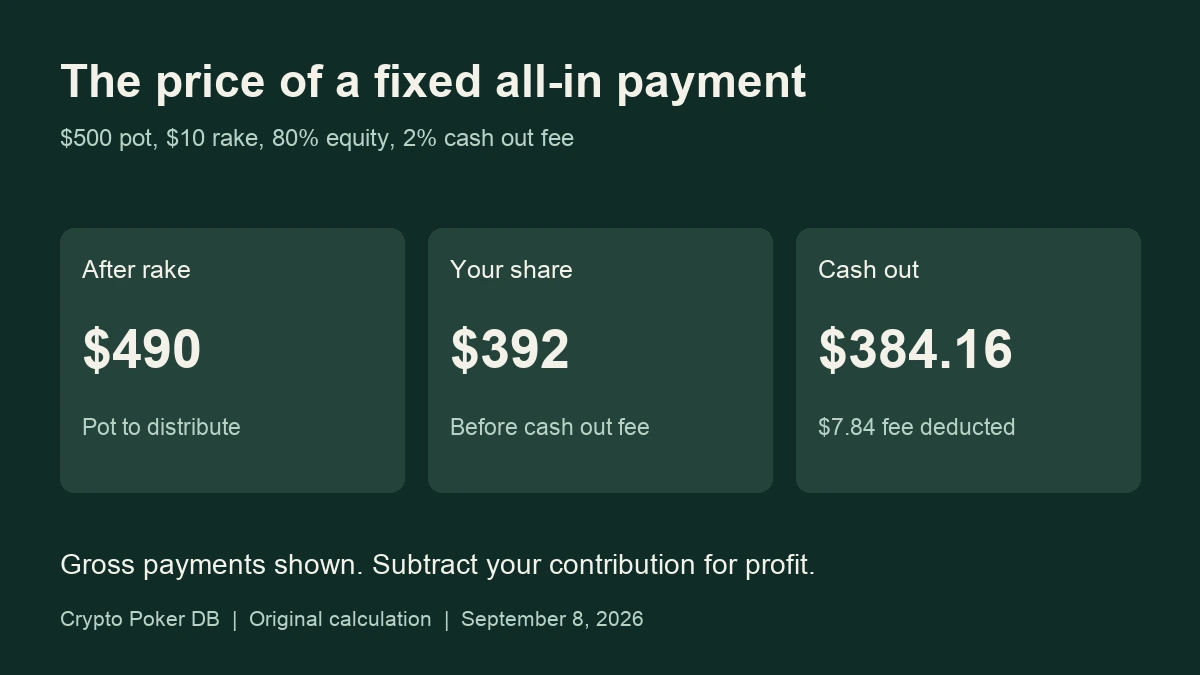
An all-in cash out fee comes out of your hand's value. On a $500 pot with $10 rake and 80% equity, a 2% charge costs $7.84. The guaranteed gross payment is $384.16, compared with a $392 average return if you play out the hand.
There is a source mismatch worth checking before you use an old example. PokerStars' current All-in Cash Out page lists 2%. Its August 2019 launch article lists 1%. We checked both on September 8. This does not establish when a rate changed or what every regional client charges.
The calculations below compare those two rates using the same invented pot. They measure the price of accepting a fixed payment after the betting is over. They do not describe a withdrawal fee or a decision to leave a cash game.
The fee is $7.84 after rake and equity are applied
Assume two players are all-in, no further action is possible, and a $500 pot has $10 in rake. There are no side pots or tied outcomes in this example. The 80% chance is an input for the model, not the calculated equity of a named starting hand.
First remove rake: $500 - $10 = $490. Your hand's average gross return is then 0.80 × $490 = $392. Apply the cash out fee to that $392 value. At 2%, the charge is $392 × 0.02 = $7.84, leaving $384.16.
PokerStars publishes this order of calculation on its current feature page. Applying 2% to the entire $500 pot would give a $10 fee, which is a different calculation. Charging rake again after using the $490 net pot would also count the same cost twice.
For your own hand, use the displayed pot, the applicable rake, and the equity of the exact cards. The poker equity calculator can check a matchup. A provider's rounded percentage may not reproduce its quoted offer to the cent.
The same pot costs more to cash out when your share is larger
For a pot available for distribution of P, equity e, and cash out fee f, the model is cash out = P × e × (1 - f). The amount paid for certainty is P × e × f.
Holding the net pot at $490 gives the following results. Each equity row is a separate scenario. No row predicts how often a particular player reaches that position.
| Equity | Average gross return without cash out | Fee at 1% | Fee at 2% | Gross cash out at 2% |
|---|---|---|---|---|
| 20% | $98.00 | $0.98 | $1.96 | $96.04 |
| 50% | $245.00 | $2.45 | $4.90 | $240.10 |
| 80% | $392.00 | $3.92 | $7.84 | $384.16 |
| 95% | $465.50 | $4.66 | $9.31 | $456.19 |
The 95% row has the largest fee in dollars because it sells the largest claim on the pot. The fee remains the same 2% of hand value in every row. It is not a two-percentage-point reduction in the chance of winning.
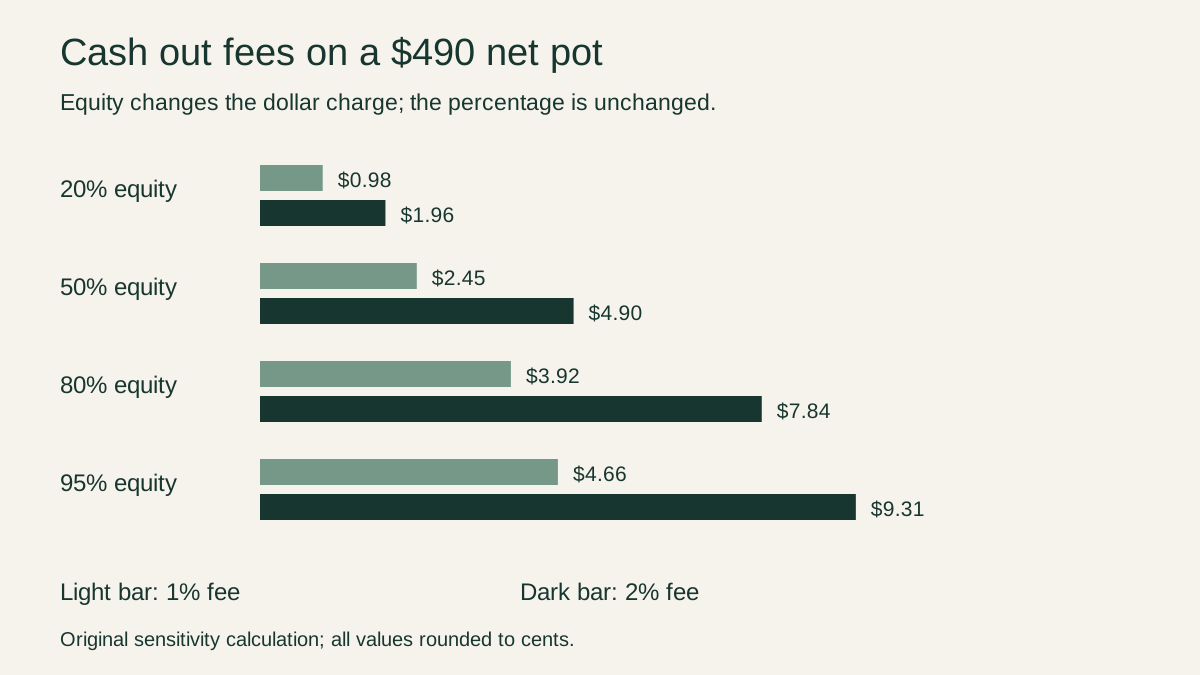
The chart holds the pot constant to isolate the fee. Real pots, rake caps, and offers vary.
A $384.16 payment can still contain only $134.16 profit
Suppose you contributed $250 to the original $500 pot. A $384.16 cash out returns that contribution plus $134.16. The payment displayed in the client is larger than the profit from the hand.
Without cash out, the net result in this simplified model is +$240 on a win and -$250 on a loss. Its average is 0.80 × $240 + 0.20 × (-$250) = $142. Cashing out fixes the modeled net result at $134.16. The difference is the same $7.84 charge.
Looking only at the final board gives a poor account of this purchase. One lost runout can make cash out look cheap. One winning runout can make it look expensive. Record the quoted offer and pre-fee hand value at the decision, then subtract them. That difference is the price paid regardless of the river.
Twenty identical offers would cost $156.80
Accepting twenty offers with a $392 pre-fee value would incur $392 × 0.02 × 20 = $156.80 in cash out fees. At 1%, the same set would cost $78.40. These are conditional cost totals, not forecasts of how many all-ins you will play or how much you will win.
For a real record, add the fees across accepted offers: total cost = sum of each hand value × its fee rate. Different pot sizes cannot be counted as if they were identical. Compare the total with your results after rake, with cash out fees counted once.
A fixed payment removes the remaining card-result variation from that claim on the pot. It can have personal value to a player who wants less exposure, but the fee reduces expected monetary return. Running a hand twice has a different payout distribution and does not guarantee a fixed return.
Before accepting, compare the actual offer with your pre-fee hand value. Check your own client's rules and eligibility; this calculation does not establish access to PokerStars or any other operator in a US state.
Sources: PokerStars current cash out formula and PokerStars' dated 2019 explanation. Dollar examples and the comparison chart are original calculations using the stated assumptions.

Maria Santos
Tournament Strategist · 6 years
Maria covers the crypto poker tournament circuit from Sunday majors to flagship series on CoinPoker and ACR. She breaks down ICM spots, final table dynamics, and satellite strategy with a clarity that appeals to beginners and seasoned MTT players alike. Her live reports from major online series have become must-reads. Trains for marathons between tournament sessions, having completed six so far.
Read next
Poker rake caps: when a $3 cap saves you nothing
At 5% rake, a $3 cap starts saving money above a $60 pot. Compare $3 and $5 caps across small pots and a fixed 100-pot sample.
3 min read
Poker re-entry: more chances to cash, more money spent
A second tournament entry can improve your chance of a payout without improving your profit. Our simple $110 example shows why.
3 min read
Poker straddle win rate: one $600 result, three rates
An original mixed-straddle session model shows why dollars per hour, posted bb/100, and active-blind units can give different readings of the same profit.
5 min read