
Poker Satellite Overlay Math: When a $110 Entry Is Worth $120
Calculate poker satellite overlay value, fee-adjusted ROI and bubble risk with a worked $12,000 guarantee and equal-seat payout model.

A poker satellite has an overlay when the guaranteed value of its seats is greater than the money players put into the prize pool. That gap can make an entry profitable before skill, but only if the ticket has full value to you.
Consider a satellite with 100 entries at $100 plus a $10 fee. It guarantees 12 tickets worth $1,000 each.
Guaranteed seat value = 12 × $1,000 = $12,000
Player prize contributions = 100 × $100 = $10,000
Overlay = $12,000 - $10,000 = $2,000
The average gross prize value is $120 per entry. After the $110 total entry cost, the field has an average expected value of $10 per entry and a fee-adjusted ROI of 9.09%.
The guarantee changes the entry value before the first hand
The quickest overlay check uses four numbers from the lobby: entries, prize-pool contribution, fee and guaranteed seat value.
Average gross value = guaranteed value ÷ entries
Entry EV = average gross value - total entry cost
Entry ROI = entry EV ÷ total entry cost
The guarantee in this example is fixed at $12,000. The value changes as more players enter.
| Entries | Prize contributions | Overlay | Average gross value | EV after $110 entry | ROI |
|---|---|---|---|---|---|
| 80 | $8,000 | $4,000 | $150.00 | $40.00 | 36.36% |
| 100 | $10,000 | $2,000 | $120.00 | $10.00 | 9.09% |
| 109 | $10,900 | $1,100 | $110.09 | $0.09 | 0.08% |
| 110 | $11,000 | $1,000 | $109.09 | -$0.91 | -0.83% |
| 120 | $12,000 | $0 | $100.00 | -$10.00 | -9.09% |
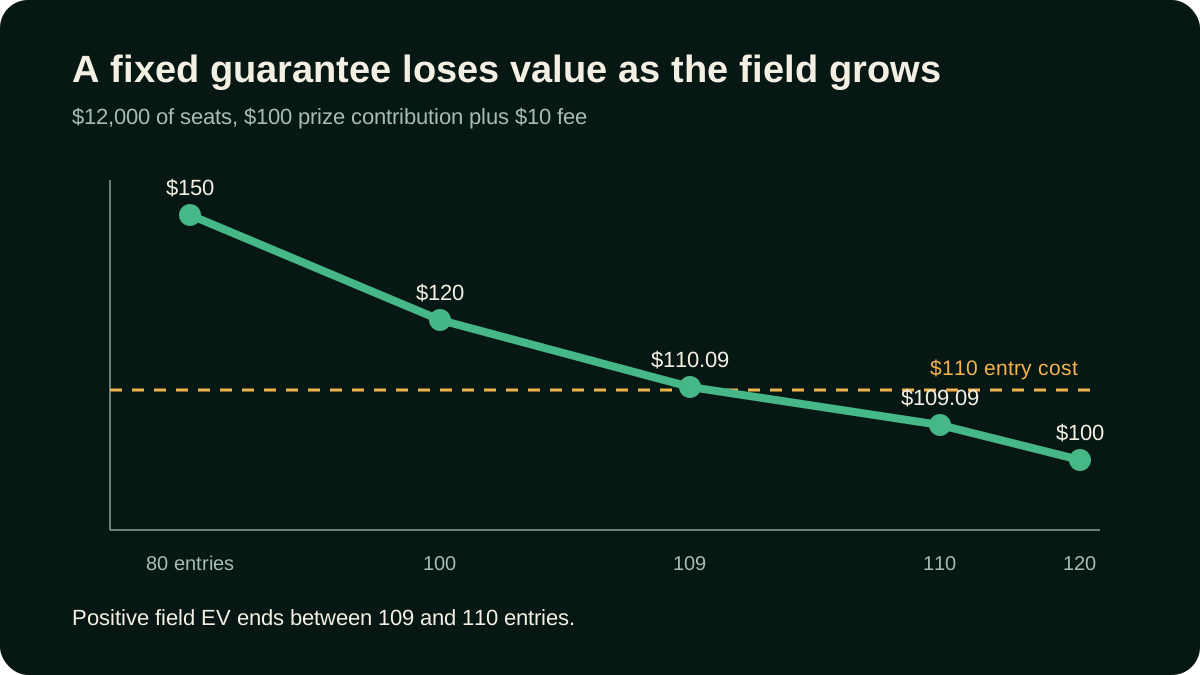
The break-even field is not 120 entries because players also pay the $10 fee. Solve for the point where average prize value equals the full $110 cost:
Break-even entries = $12,000 ÷ $110 = 109.09
At 109 entries, a small positive edge remains. At 110 entries, the average entry is slightly negative before skill.
Use the tournament ROI calculator after you play to track your actual results. The table above is a field-level value check, not a forecast for one player.
A $1,000 ticket may be worth less than $1,000 to you
Satellite prizes often have restrictions. PokerStars states that a satellite ticket may need to be used for the target event and may not always be exchanged for cash. Its current Player's Choice policy gives some tickets more flexibility, but the terms depend on the event and licence.
Discount the ticket before you calculate your personal EV if:
- you cannot play the target event;
- the ticket expires before you can use it;
- travel, accommodation or time away from work adds a cost;
- the ticket cannot be transferred or exchanged;
- the target event is too large for your normal bankroll.
If a $1,000 ticket is worth only $800 to you, the example guarantee has a personal value of $9,600. The apparent $2,000 overlay disappears.
Personal guarantee value = 12 × $800 = $9,600
Personal average value = $9,600 ÷ 100 = $96
Personal EV = $96 - $110 = -$14
The lobby can show positive field value while the tournament is a bad purchase for your own plans.
Equal seats make bubble chips non-linear
PokerStars describes a standard multi-table satellite as a tournament that stops when enough players remain to award equal-value seats. This flat payout makes bubble decisions different from a normal final table.
Take a simplified bubble with six equal stacks, five $1,000 tickets and no other prize. By symmetry, each player has a five-in-six chance to win a ticket.
Current ticket equity = 5 ÷ 6 × $1,000 = $833.33
Now suppose one player can take a fair all-in against another equal stack. The winner is certain to get a ticket because one player is eliminated. The loser gets nothing.
All-in equity = 50% × $1,000 + 50% × $0 = $500
A fair chip gamble cuts the player's prize equity from $833.33 to $500 in this narrow model. The chance to double chips is not worth the chance of losing a nearly secured equal prize.
This example assumes equal stacks, a 50% all-in, no blinds during the decision and immediate tournament completion after one elimination. Real satellite choices need every stack, blind pressure, position and future action. The model explains the pressure. It does not produce a universal fold range.
Check the lobby again near late registration
Overlay value can shrink quickly near the end of registration. A tournament that looks attractive with 80 entries can become negative at 110 entries under the same guarantee.
Record these details before you register:
| Lobby item | What to verify |
|---|---|
| Seat count | Fixed seats or one seat per full target buy-in |
| Ticket value | Seat only, package, cash or tournament credit |
| Entry split | Amount to the prize pool and separate fee |
| Late registration | Closing time and re-entry rules |
| Ticket use | Target event, expiry and exchange terms |
| Cancellation rule | What happens if the event does not start |
Current X posts show why the last line matters. A September 3 satellite in Osaka was cancelled after the minimum player count was not met. A guarantee does not always mean the operator must run the event with any field size. Read the cancellation terms before treating the full guarantee as certain.
A July r/poker post also described a tournament with far more guaranteed value than its entry pool. The arithmetic drew attention because the overlay was large. The post is an audience signal, not proof of a repeatable offer. Use the live lobby and terms for the event you plan to enter.
The best overlay can still be a bad bankroll decision
A positive field EV does not remove tournament variance. Most players in a satellite still leave without a ticket. The $110 entry is fully at risk, and a ticket may lead to a target event with much larger swings.
Set a satellite budget that fits your normal tournament bankroll. Do not count a restricted ticket as cash, and do not chase a late entry only because the overlay percentage looks large.
Poker involves financial risk. Set a fixed tournament budget and do not use money needed for bills, rent or debt payments.
Sources for the satellite rules and examples
- PokerStars: poker tournament types and satellite rules, checked September 5, 2026.
- PokerStars: satellite ticket policy, checked September 5, 2026.
- MIT OpenCourseWare: Mega Satellite case study, checked September 5, 2026.
- r/poker: tournament overlay discussion, published July 27, 2026. Used only as an audience signal.
- X: satellite cancellation notice, published September 3, 2026. Used only as a current event signal.

Maria Santos
Tournament Strategist · 6 years
Maria covers the crypto poker tournament circuit from Sunday majors to flagship series on CoinPoker and ACR. She breaks down ICM spots, final table dynamics, and satellite strategy with a clarity that appeals to beginners and seasoned MTT players alike. Her live reports from major online series have become must-reads. Trains for marathons between tournament sessions, having completed six so far.