
What 96% Slot RTP Means After 500 Spins
Calculate the expected loss for 500 slot spins at 96% RTP, see why one session can finish far from 96%, and learn which game details to check first.
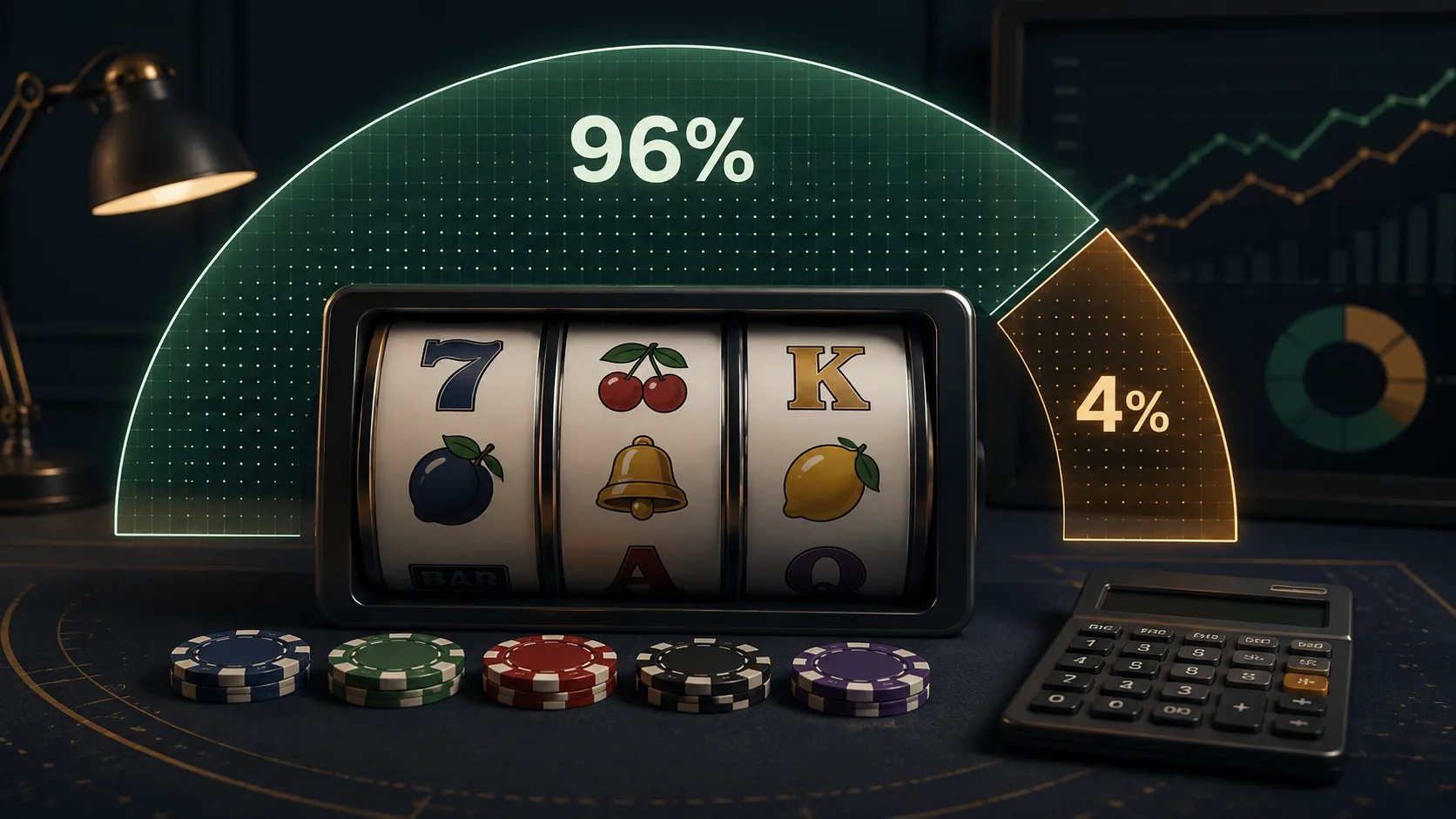
A slot with 96% return to player does not promise to return $96 from a $100 deposit. It means the game is designed to return about 96% of total stakes over a very large number of plays. The remaining 4% is the theoretical house edge.
At $0.50 a spin for 500 spins, total turnover is $250. The theoretical expected loss is $10.
Expected loss = total stake × (1 - RTP)
$250 × (1 - 0.96) = $10
Your actual result can be far above or below that figure. RTP describes a long-run average, not the result of one session.
RTP applies to turnover, not your opening deposit
Turnover is the total of every stake placed. It includes money that you win and then bet again.
A player may deposit $100 and place $250 of total wagers by recycling smaller wins. The expected-loss calculation uses $250 because that is the amount exposed to the game, even though only $100 entered the account.
The UK Gambling Commission uses the same distinction. It defines actual RTP as wins divided by turnover and states that turnover includes reinvested winnings.
Expected loss grows with every spin
The table uses a 96% theoretical RTP and fixed bets. It does not predict the cash balance after the last spin.
| Bet per spin | Spins | Total turnover | Theoretical expected loss |
|---|---|---|---|
| $0.20 | 500 | $100 | $4 |
| $0.50 | 500 | $250 | $10 |
| $1.00 | 500 | $500 | $20 |
| $2.00 | 500 | $1,000 | $40 |
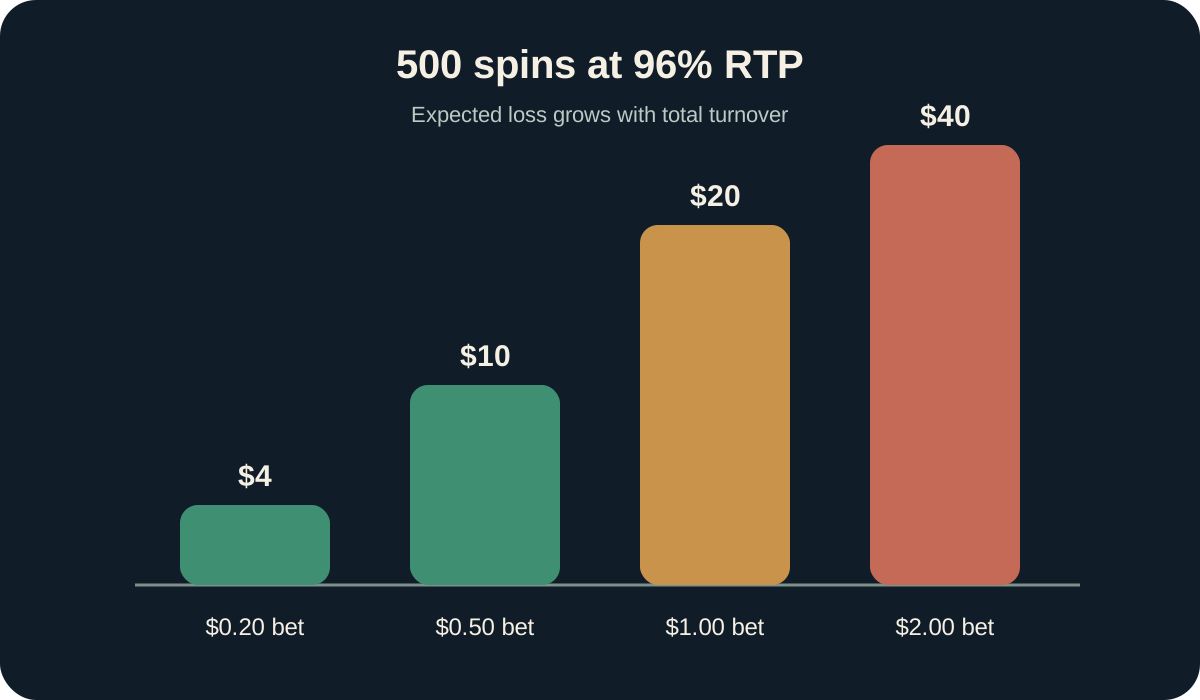
The relationship is linear. Doubling the bet doubles turnover and expected loss when the RTP and number of spins stay the same.
Spin speed also matters. A player who makes 500 spins in 50 minutes exposes more money per hour than a player who makes 500 spins in 100 minutes. The game RTP is unchanged, but the hourly cost is different.
Five hundred spins cannot verify a 96% setting
Players often record a few hundred spins and compare the result with the advertised RTP. That sample is too small to prove that a random slot is set correctly or incorrectly.
The UK Gambling Commission gives a useful scale. In its worked monitoring example, a game with standard deviation of 5.6 still has a 95% tolerance of about 4.91 percentage points after 50,000 plays. The tolerance narrows to about 1.10 points only after 1,000,000 plays.
The exact range depends on the game's volatility. A high-volatility slot can produce larger short-run swings because more of its return comes from rare, large prizes.
This is why a 60% result after 500 spins does not prove that the game has a 60% theoretical RTP. It is also why a 140% result does not prove that the game is generous. Both figures describe the sample you observed, not the game's certified long-run design.
The same RTP can hide very different games
Two slots can both show 96% RTP and still feel completely different.
Our hit frequency comparison shows two simple games with the same return but very different chances of ten empty spins.
One game may pay small prizes often. Another may direct more of its return to rare bonus rounds or a jackpot. The long-run percentage can match while the volatility, hit frequency and bankroll swings differ.
Check whether the displayed RTP:
- changes with the selected bet or game mode;
- includes a progressive jackpot contribution;
- assumes an optional bonus feature is active;
- is theoretical RTP or recent actual RTP;
- depends on a strategy or player choice.
Gaming Laboratories International says that displayed theoretical RTP should explain whether it is a minimum, maximum or average and how a player can achieve it. If actual RTP is advertised, the number of plays and the measurement period should also be shown.
Read the game information before the first spin
Open the game's help or information screen and record four details: RTP, volatility, paytable and bonus conditions. If the casino offers several versions of one slot, check the active version instead of trusting a search result or promotional page.
This check also matters when you compare operators. On a casino review such as our Wild Casino review, use the operator information to assess access and payments, then verify the RTP inside the exact game you plan to open. A casino name cannot tell you which RTP configuration is active for every slot.
Set a turnover limit as well as a deposit limit. For example, a $250 turnover cap at 96% RTP carries a $10 theoretical expected loss. It does not cap the actual loss at $10, but it controls how much money you expose to the edge.
Reddit slot discussions show why this distinction needs more attention. Players often post short samples and call the result an RTP test. The better replies point back to sample size and volatility. That correction is sound, but the regulator's calculation is the stronger source.
Slots involve financial risk. Set a fixed loss limit and time limit before play. Do not chase a result because a short session is below the advertised RTP.
Sources for the RTP calculation
- UK Gambling Commission: return to player explained, checked September 4, 2026.
- UK Gambling Commission: how to calculate RTP, checked September 4, 2026.
- UK Gambling Commission: RTP monitoring terms, checked September 4, 2026.
- Gaming Laboratories International: GLI-19 Interactive Gaming Systems, checked September 4, 2026.

Emily Chen
Blockchain Casino Analyst · 6 years
Emily reviews how crypto casinos use blockchain systems in practice. She checks provably fair tools, wallet flows, game records, and the gap between a technical claim and what a player can actually verify. Her comparison work is built around repeatable checks rather than casino marketing copy. Away from the screen, she collects mechanical keyboards and is still looking for a quiet switch she genuinely likes.
Read next
Dealer hits soft 17: about $2.20 extra per $1,000 bet
Compare H17 and S17 blackjack with a simple dollar model. See the added expected loss at $5, $10 and $25 bets while all other rules stay the same.
3 min read
No-Commission Baccarat vs 5% Commission: The $40 Difference
Compare standard Banker commission with Super 6 no-commission baccarat, including house edge, $10,000 expected loss and the rule to check.
8 min read
Roulette first-five bet: same numbers, $2 less on a win
A $10 first-five roulette bet pays $60 profit. Five $2 straight bets on the same numbers pay $62 profit. Compare the odds and expected cost.
3 min read