
Rakeback break-even: when 30% covers a $300 loss
See when rakeback covers a losing poker result. A 10,000-hand example compares 20%, 30% and 50% cash returns on the same eligible rake.

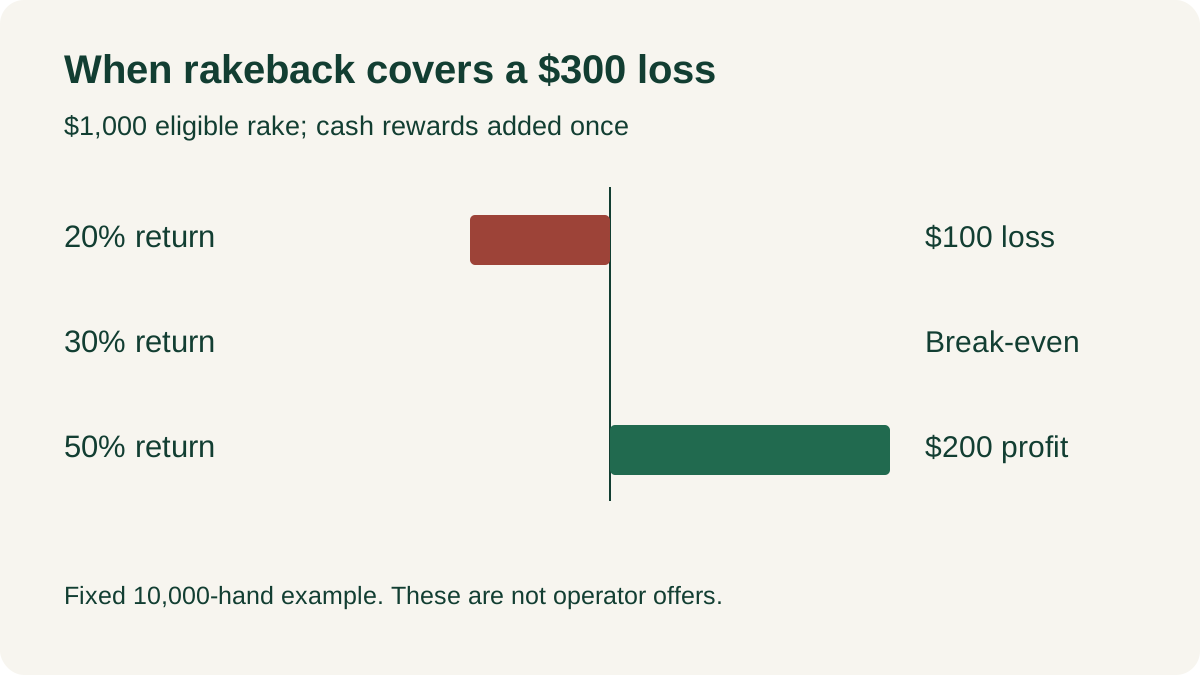
A $300 poker loss needs $300 in usable rewards to break even. If your eligible rake is $1,000, that means a 30% cash return. A 20% return leaves you $100 behind.
Our example uses 10,000 hands at a $1 big blind. The player loses 3 big blinds per 100 hands after rake, before rewards. That adds up to a $300 loss. We keep those results fixed and change only the reward rate.
How three reward rates change the same loss
Suppose the room attributes $1,000 of eligible rake to this player over those hands. At 30%, it returns $300 in cash. Add that to the $300 loss and the final result is zero.
| Cash return | Reward | Final result |
|---|---|---|
| 20% | $200 | $100 loss |
| 30% | $300 | Break-even |
| 50% | $500 | $200 profit |
These are example rates, not offers from a named room. The final results are equivalent to losing 1, winning 0, and winning 2 big blinds per 100 hands respectively.
Your hand history must exclude rewards for this addition to work. If your reported profit already includes the rebate, adding it again overstates your result. Rake has already been deducted from the playing result in our example. Do not subtract it a second time.
Use the rake that qualifies for your reward
The rake taken from a whole table is not necessarily the amount assigned to you. A room can allocate rake according to each player's contribution to a pot. ACR's official rake page describes its weighted contributed method.
Use the eligible amount shown by your own room, for the same period as your playing result. Do not substitute the rake from every pot you won. Check which games count and whether the reward has a cap.
For this example, 10,000 hands with $1,000 eligible rake means $10 of eligible rake per 100 hands. Use the rakeback calculator to estimate returns at different volumes and compare its example rates. Replace estimates with your account's actual eligible rake when you check a completed month.
Count cash you can use. A ticket you cannot use does not cover a cash loss at its face value. Keep points, tickets and conditional bonuses separate until you know what they returned.
Find the percentage that covers your loss
Divide the loss before rewards by eligible rake: $300 ÷ $1,000 = 30%. This is the minimum usable return needed for this sample. If eligible rake were only $600, covering the same loss would require 50%.
The model assumes cash rewards with no deductions, limits or extra requirements. It excludes deposit costs and currency changes. A 10,000-hand result is a record of that sample; it does not establish your long-term win rate or predict next month's result.
If you keep losing the same amount per 100 hands after rewards, more hands mean a larger dollar loss. Do not add sessions just to chase a reward tier.
Calculation and source checked September 17, 2026. The table is our worked example, not player account data.
Published September 17, 2026. Updated September 17, 2026.

Ryan Taylor
Player Coach · 5 years
Ryan specializes in making poker and crypto accessible to complete beginners. He writes step-by-step guides on everything from setting up a Bitcoin wallet to understanding position at the table. His coaching content focuses on building solid fundamentals before moving up in stakes. Players appreciate his patient, jargon-free explanations. Catches waves at his local break whenever the swell is right.
Read next
Poker cash out fees: what 2% costs on a $500 pot
A $500 all-in model separates rake, cash out fees, and profit. Compare 1% and 2% charges on hand value, with an original cost table.
5 min read
Poker rake caps: when a $3 cap saves you nothing
At 5% rake, a $3 cap starts saving money above a $60 pot. Compare $3 and $5 caps across small pots and a fixed 100-pot sample.
3 min read
Poker re-entry: more chances to cash, more money spent
A second tournament entry can improve your chance of a payout without improving your profit. Our simple $110 example shows why.
3 min read