
Poker rake caps: when a $3 cap saves you nothing
At 5% rake, a $3 cap starts saving money above a $60 pot. Compare $3 and $5 caps across small pots and a fixed 100-pot sample.
At 5% rake, a $3 cap and a $5 cap both take $1 from a $20 pot. The lower cap starts saving money only when the pot exceeds $60.
Our fixed sample of 100 pots produces $140 in table rake with the $3 cap and $150 with the $5 cap. The saving is $10 across the table. A lower advertised cap does not cut every pot's fee.
Small pots can pay the same fee
A rake cap is the most the room takes from an eligible pot. The percentage sets the fee until that limit applies. PokerStars describes this common structure in its explanation of pot rake.
The rates below are our example, not a current offer from a named room. Each pot qualifies for rake, and both rooms charge exactly 5% with no extra drop or rounding.
| Pot before rake | With a $3 cap | With a $5 cap | Saving |
|---|---|---|---|
| $20 | $1 | $1 | $0 |
| $40 | $2 | $2 | $0 |
| $60 | $3 | $3 | $0 |
| $80 | $3 | $4 | $1 |
| $100 | $3 | $5 | $2 |
For a $100 pot, the winner receives $97 or $95 after rake. That amount includes chips already in the pot. It is not the winner's net profit on the hand.
The mix of pots sets the total saving
Suppose a table plays 70 eligible $20 pots, 20 at $40, and 10 at $80. That is $3,000 in total pots before fees.
Only the ten $80 pots benefit from the lower cap. Each saves $1, giving the $10 total difference. The effective table fee falls from about 5.00% to 4.67% of the total pot money.
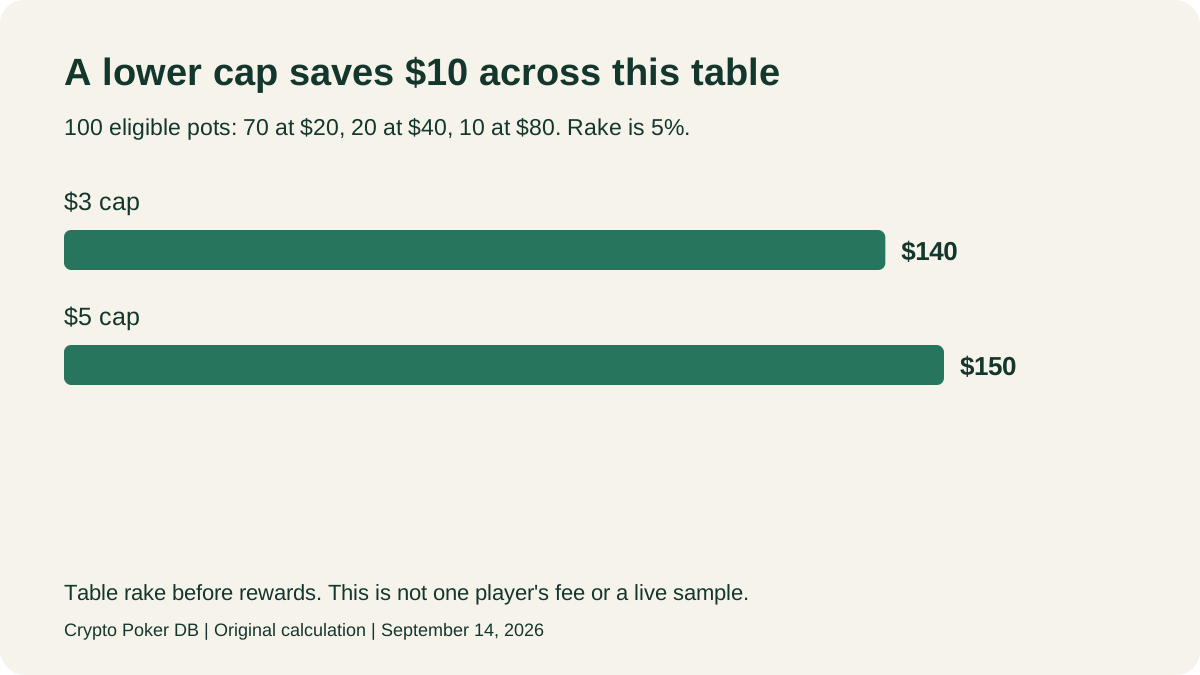
This is a constructed sample, not a measurement of a live game. It does not assign the $10 saving to one player. Your results depend on the pots you enter and win, and any rewards credited to you.
Use the rake calculator to compare your pot sizes. Check the same stake, table size, percentage, cap, and extra fees in each room. Then use the rakeback guide to compare usable rewards separately.
How we checked the $60 threshold
For this model, rake is the smaller of 5% of the pot or the cap. Dividing $3 by 0.05 gives $60. The two fees are still equal at that point; savings begin above it.
The sample totals are 70 × $1 + 20 × $2 + 10 × $3 = $140 and 70 × $1 + 20 × $2 + 10 × $4 = $150. We checked these calculations on September 14, 2026.
Real rooms can change caps by player count or use a no-flop, no-drop rule. Read the applicable table rules before using either figure in a cost comparison.

Ryan Taylor
Player Coach · 5 years
Ryan specializes in making poker and crypto accessible to complete beginners. He writes step-by-step guides on everything from setting up a Bitcoin wallet to understanding position at the table. His coaching content focuses on building solid fundamentals before moving up in stakes. Players appreciate his patient, jargon-free explanations. Catches waves at his local break whenever the swell is right.
Read next
Poker cash out fees: what 2% costs on a $500 pot
A $500 all-in model separates rake, cash out fees, and profit. Compare 1% and 2% charges on hand value, with an original cost table.
5 min read
Poker re-entry: more chances to cash, more money spent
A second tournament entry can improve your chance of a payout without improving your profit. Our simple $110 example shows why.
3 min read
Poker straddle win rate: one $600 result, three rates
An original mixed-straddle session model shows why dollars per hour, posted bb/100, and active-blind units can give different readings of the same profit.
5 min read