
Time rake vs pot rake: when a $12 seat fee costs less
Compare a $12 hourly poker fee with $4 taken from each pot you win. Our worked example shows the break-even point and how a daily fee changes it.

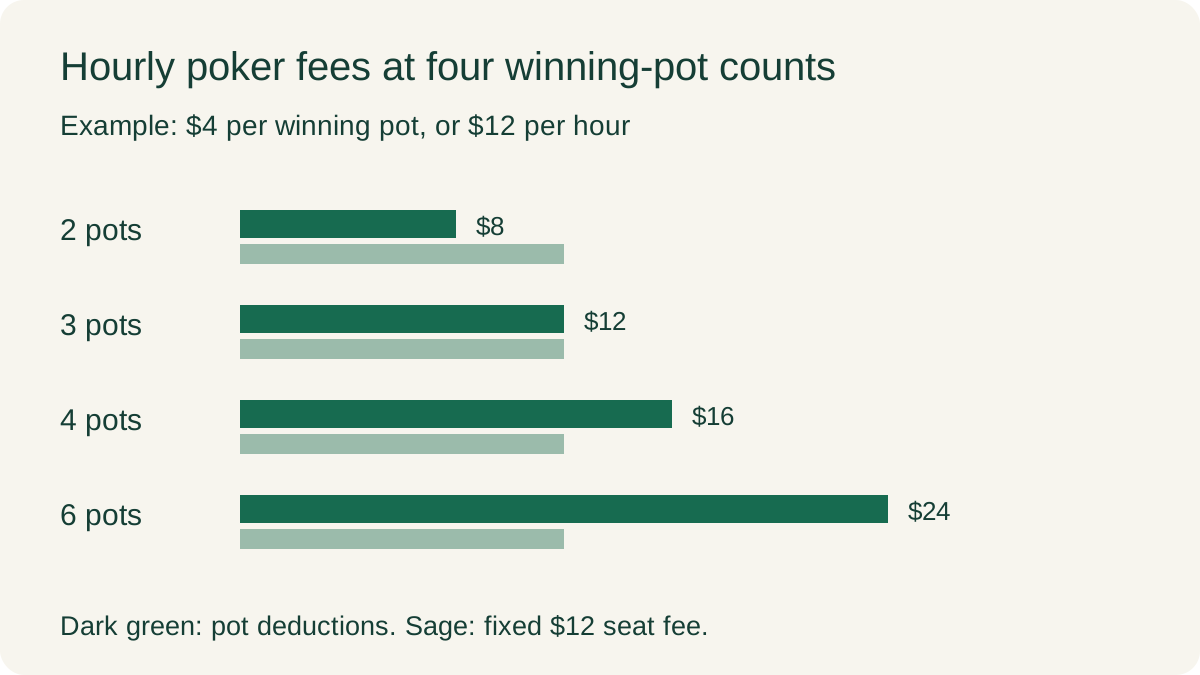
A $12 hourly seat fee costs less than $4 taken from each pot you win once you win more than three such pots per hour. At two winning pots, the pot deductions total $8. At four, they total $16. The seat fee stays $12.
These are example prices, not a quote from a poker room. We compare the direct deductions from your winnings. This is a fee comparison, not a prediction that you will win money.
Three $4 deductions equal one $12 hour
With pot rake, the room removes money from a pot before paying the winner. With time rake, you pay for your seat while the clock runs. Folding every hand does not remove that time charge.
The Lodge describes hourly seat rental as its cash-game fee model, with separate club access fees. That source confirms the model. Our $12 and $4 figures below are assumptions; check a room's current prices before you travel.
| Pots you win in one hour | $4 deducted per win | $12 seat fee | Lower direct cost |
|---|---|---|---|
| 2 | $8 | $12 | Pot rake by $4 |
| 3 | $12 | $12 | Equal |
| 4 | $16 | $12 | Seat fee by $4 |
| 6 | $24 | $12 | Seat fee by $12 |
Use the amount actually removed from your winning pots. A posted $4 cap does not mean every pot reaches $4. Small pots, uncalled bets and the room's no-flop rules can change the deduction.
A daily fee changes the break-even point
Suppose the time-charge room also collects a $10 daily fee. Over a five-hour visit, that adds $2 per hour. Your effective fee becomes $14 per hour, or $70 for the visit.
At $4 per winning pot, you now need 3.5 such pots per hour for the charges to match. Over five hours, 17 winning pots cost $68 in pot rake; 18 cost $72. The $70 time charge sits between them.
For a two-hour visit, the same daily fee adds $5 per hour. The effective cost rises to $17 per hour. Short visits make a fixed entry fee more expensive per hour.
Compare your own deductions before changing rooms
Record playing hours, fees paid and the deductions from pots you win. Compare similar stakes and table conditions. Split pots need your share of the deduction, rather than the full pot's rake.
This accounting model leaves out tips, promotions, travel and differences in opponents. It also does not measure how rake changes other players' stacks or later decisions. A cheaper fee schedule alone cannot establish which game earns more.
Use the poker win-rate calculator to convert your recorded net results into an hourly rate. If those results already include rake, do not subtract the same rake again. Deduct separately paid seat or entry fees once.
Calculation: hourly pot deductions = winning pots per hour × average deduction per winning pot. Effective time fee = hourly seat price + daily fee ÷ hours played. Divide the effective time fee by the average pot deduction to find the break-even count.
Calculation and source checked September 21, 2026. Published September 21, 2026. Updated September 21, 2026.

Ryan Taylor
Player Coach · 5 years
Ryan specializes in making poker and crypto accessible to complete beginners. He writes step-by-step guides on everything from setting up a Bitcoin wallet to understanding position at the table. His coaching content focuses on building solid fundamentals before moving up in stakes. Players appreciate his patient, jargon-free explanations. Catches waves at his local break whenever the swell is right.