
Set mining: what a $5 call needs to win
Our $5 set-mining example shows why the money you expect to win matters more than the stack available. See the break-even payoff in dollars.
Having $100 available to win does not make every $5 call with a small pocket pair profitable. You also need opponents to pay you enough when you hit.
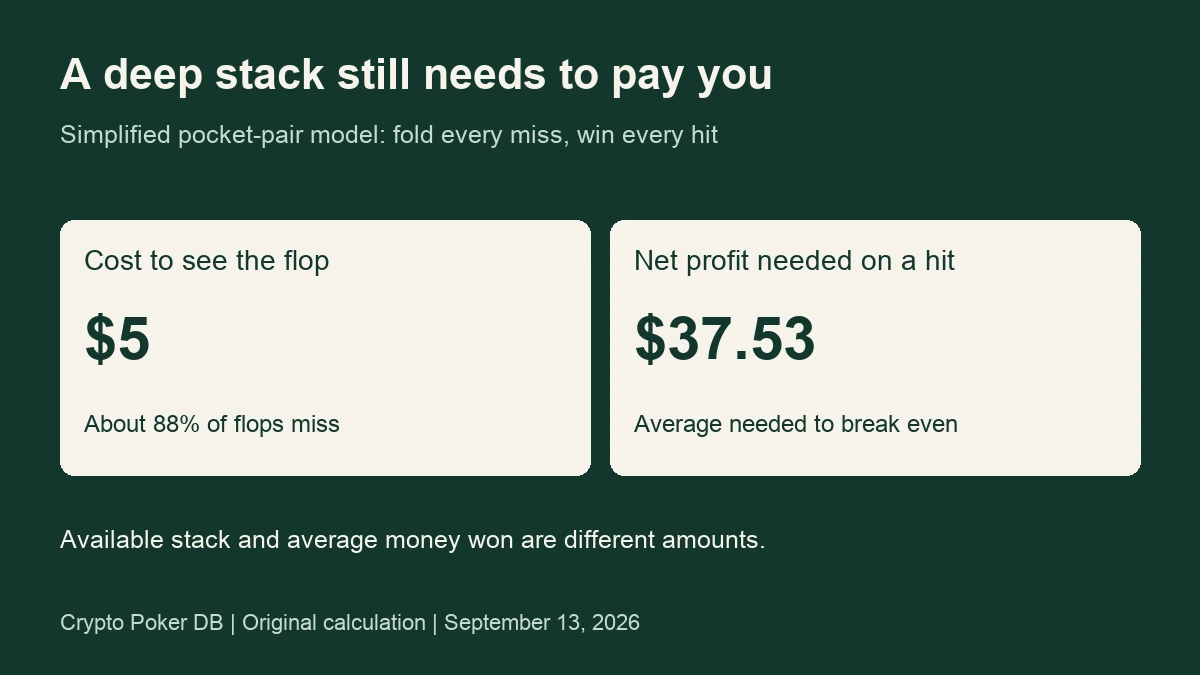
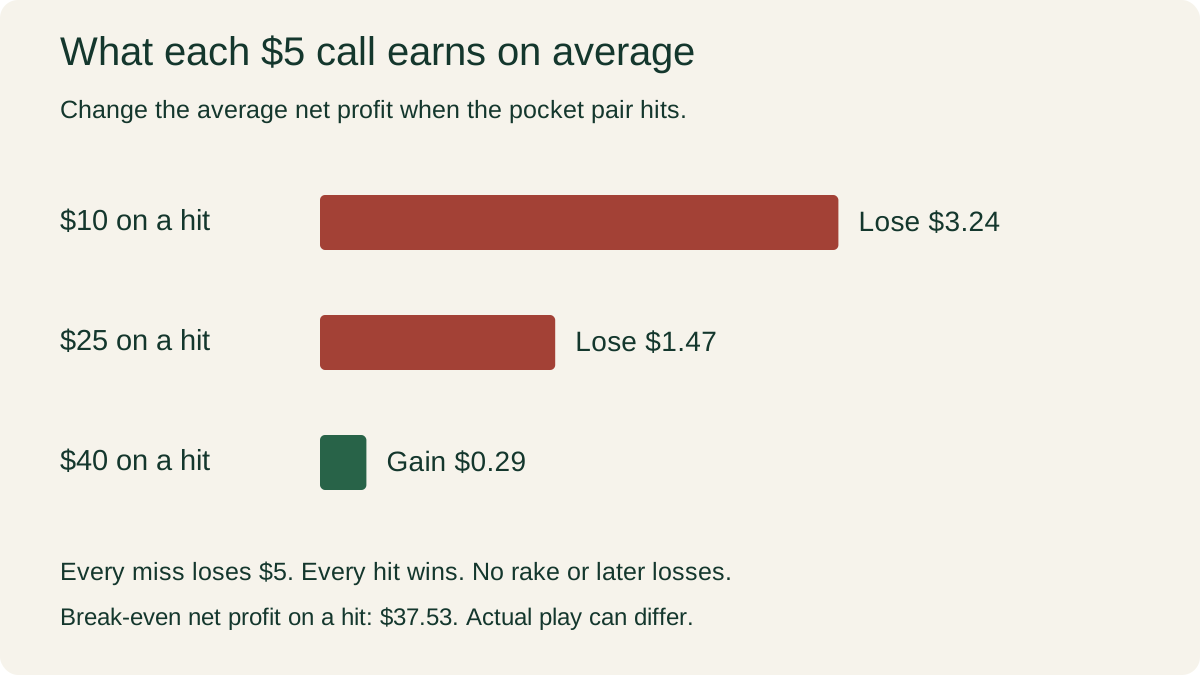
Our simple model needs about $37.53 average net profit on a hit to cover the missed flops. If the average profit on a hit is only $25, the call loses about $1.47 on average.
What the $5 call needs to earn
- You hit at least one of the two remaining cards of your pair's rank on about 12% of flops.
- You miss on about 88%. Folding those misses costs $5 each time.
- A deep stack gives you room to win more. It does not tell you how much an opponent will pay.
Set mining means calling with a pocket pair mainly to make three of a kind on the flop. This example counts the rare flop with both remaining matching cards as a hit too.
Compare the average payoff with the biggest possible win
Assume you pay $5 to see the flop. You fold every miss. Every hit wins, and you make no further losses. These are deliberately favorable assumptions.
Here is how the result changes with the amount you earn on a hit:
| Average net profit on a hit | Average result per $5 call |
|---|---|
| $10 | Lose $3.24 |
| $25 | Lose $1.47 |
| $40 | Gain $0.29 |
"Net profit" means money left after subtracting your bets. It excludes your own chips returned from the pot. The table describes many repeated calls, not a promised result for one hand.
Use the 20x rule as a starting check
A $5 call is 5% of $100. That is the idea behind a 20x stack check. PokerStars' implied-odds explanation discusses this size of call, but also warns against assuming you always win an opponent's full stack.
Check the smaller stack you can play for, then consider the opponent. Someone who often folds after the flop may pay much less than their available stack. Rake and losses after making a set can reduce the result further.
Use the implied odds calculator to test a realistic future payment. Its pot input includes money already in the middle; future winnings must exclude that money. The hit chance here is not automatically your chance of winning the hand.
How we counted the missed flops
With a pocket pair, 50 cards remain unseen. There are 19,600 possible three-card flops. Of these, 2,304 contain at least one of the two matching cards.
That gives an 11.76% hit chance. We compare the profit from those hits with a $5 loss on each miss. The break-even average net profit on a hit is $37.53, before rake.
The model assumes a random deck and no further raise before you see the flop. Real hands can win without a set or lose after making one. Record those outcomes when reviewing your own calls.

Ryan Taylor
Player Coach · 5 years
Ryan specializes in making poker and crypto accessible to complete beginners. He writes step-by-step guides on everything from setting up a Bitcoin wallet to understanding position at the table. His coaching content focuses on building solid fundamentals before moving up in stakes. Players appreciate his patient, jargon-free explanations. Catches waves at his local break whenever the swell is right.
Read next
Poker cash out fees: what 2% costs on a $500 pot
A $500 all-in model separates rake, cash out fees, and profit. Compare 1% and 2% charges on hand value, with an original cost table.
5 min read
Poker rake caps: when a $3 cap saves you nothing
At 5% rake, a $3 cap starts saving money above a $60 pot. Compare $3 and $5 caps across small pots and a fixed 100-pot sample.
3 min read
Poker re-entry: more chances to cash, more money spent
A second tournament entry can improve your chance of a payout without improving your profit. Our simple $110 example shows why.
3 min read