
Two vs four poker tables: when more hands pay less
Four poker tables do not always earn more than two. Compare $9 and $6 hourly results, and find the win rate needed to make extra tables worthwhile.
Doubling your poker tables can reduce your hourly profit if your win rate falls too far. In our example, two tables earn $9 an hour. Four tables earn only $6 when the player's win rate drops from 6 to 2 big blinds per 100 hands.
We use a $1 big blind and 75 hands per table per hour. These are example inputs, not typical earnings or a promise of profit. The win rates are after rake and before rewards.
Four tables need 3 big blinds per 100 hands to match $9
At two tables, the player sees 150 hands an hour. Winning 6 big blinds per 100 hands gives an estimated $9 hourly profit.
Four tables double the volume to 300 hands an hour. The player can then earn the same $9 at half the win rate: 3 big blinds per 100 hands. Below that rate, the extra tables reduce hourly profit.
| Tables | Hands/hour | Win rate (bb/100) | Profit/hour |
|---|---|---|---|
| 2 | 150 | 6 | $9 |
| 4 | 300 | 4 | $12 |
| 4 | 300 | 3 | $9 |
| 4 | 300 | 2 | $6 |
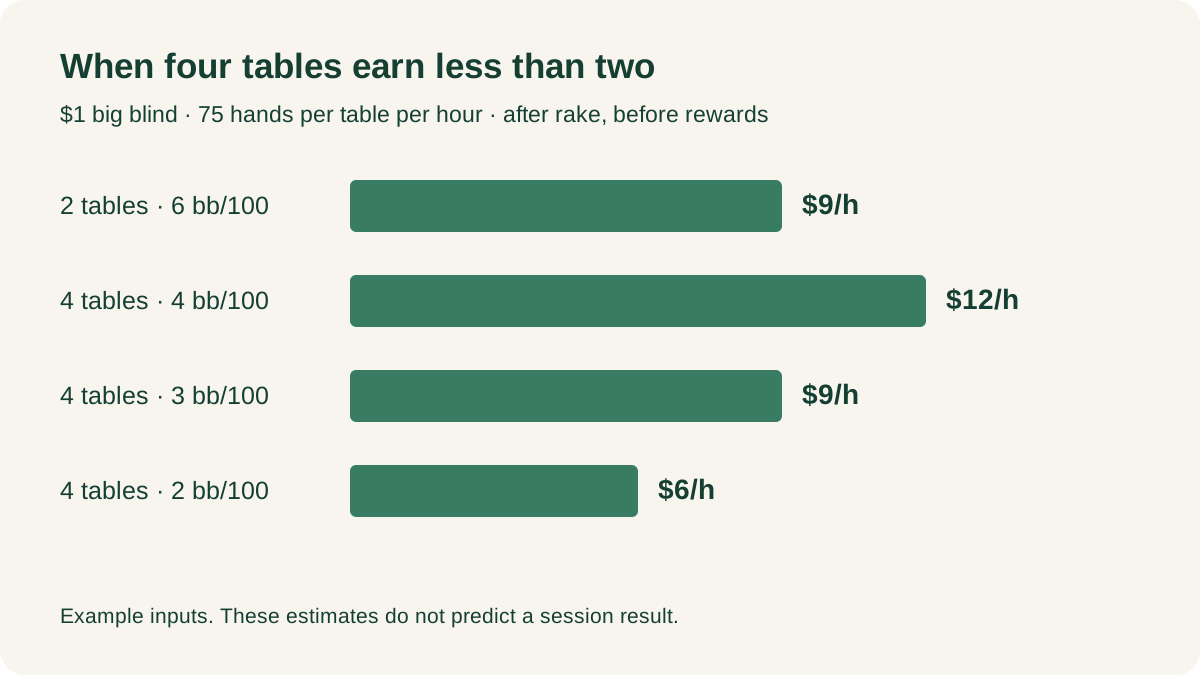
The $9 comparison is a threshold for matching the two-table result. It is not the point where poker profit becomes zero.
Compare profit over the same amount of clock time
Use your own volume in the poker win rate calculator. Enter hands per table per hour and the number of tables separately. Entering total hands in the per-table field counts the extra volume twice.
For recorded sessions, divide total profit by elapsed playing time. Four tables played together for one hour still use one hour of your time. Keep stakes, game format and reward treatment consistent when comparing results.
A few winning sessions cannot establish a reliable win rate. Review several sessions at each table count, along with missed decisions, time-outs and mistakes. A larger sample helps, but the model remains only as useful as the rates you enter.
PokerStars recommends increasing the table count gradually. That lets you check whether your decisions suffer before you commit to more volume. Table limits and available layouts depend on the room and device.
Calculate the rate your extra tables must keep
Hourly profit equals total hands per hour divided by 100, multiplied by win rate and the dollar value of a big blind. Our two-table calculation is 150 ÷ 100 × 6 × $1 = $9.
To find the four-table rate that matches it, calculate $9 ÷ (300 ÷ 100 × $1). The answer is 3 big blinds per 100 hands. If your actual volume rises by less than double, you need more than half your old win rate to match the old hourly result.
The model excludes rewards, deposit costs and currency changes. Rake is already included in the stated win rates. Do not subtract it again.
Calculation and source checked September 20, 2026. Published September 20, 2026. Updated September 20, 2026.

Ryan Taylor
Player Coach · 5 years
Ryan specializes in making poker and crypto accessible to complete beginners. He writes step-by-step guides on everything from setting up a Bitcoin wallet to understanding position at the table. His coaching content focuses on building solid fundamentals before moving up in stakes. Players appreciate his patient, jargon-free explanations. Catches waves at his local break whenever the swell is right.
Read next
Poker cash out fees: what 2% costs on a $500 pot
A $500 all-in model separates rake, cash out fees, and profit. Compare 1% and 2% charges on hand value, with an original cost table.
5 min read
Poker rake caps: when a $3 cap saves you nothing
At 5% rake, a $3 cap starts saving money above a $60 pot. Compare $3 and $5 caps across small pots and a fixed 100-pot sample.
3 min read
Poker re-entry: more chances to cash, more money spent
A second tournament entry can improve your chance of a payout without improving your profit. Our simple $110 example shows why.
3 min read