
Roulette la partage: half the loss on $10 bets
La partage cuts expected loss from $27.03 to $13.51 over 100 ten-dollar even-money bets. See what changes on zero and what stays the same.
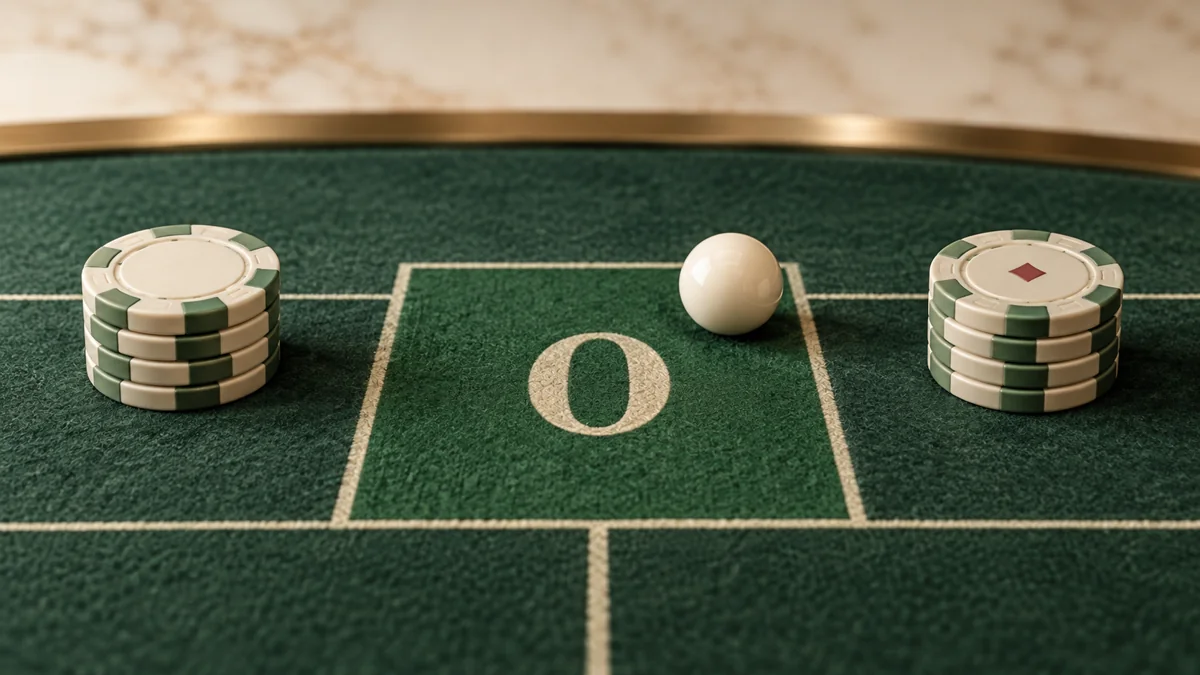
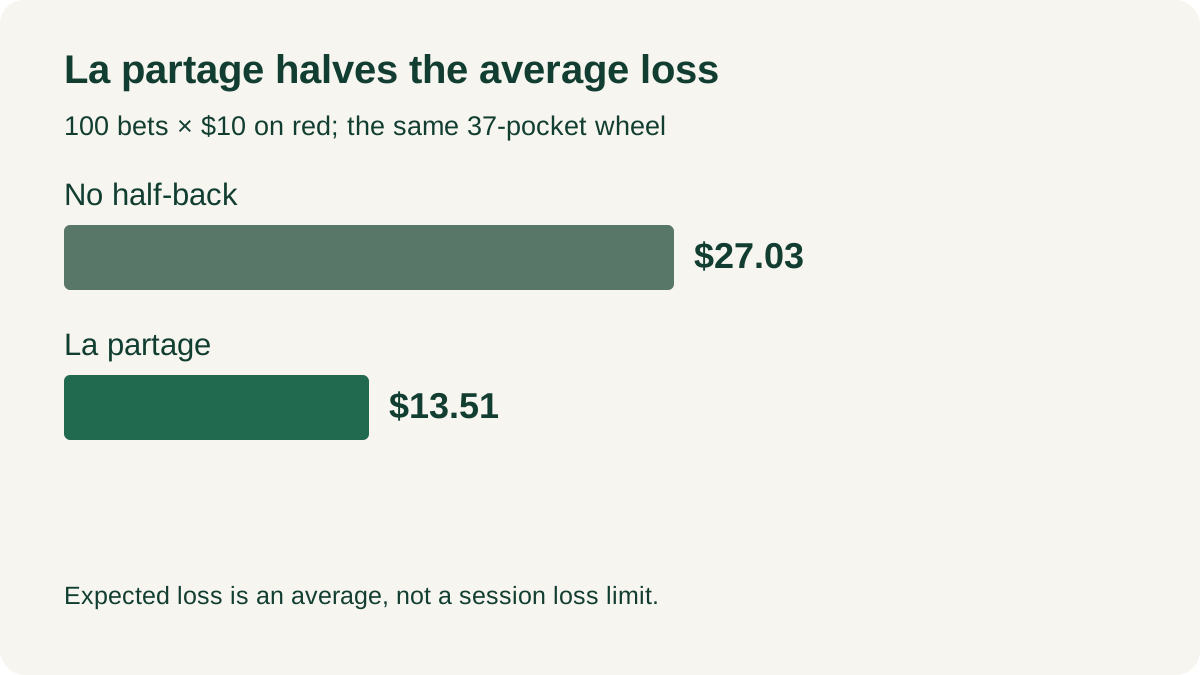
La partage cuts the expected loss on 100 ten-dollar red bets from $27.03 to $13.51. It returns half your stake when zero lands. You still lose money on average, but the cost of that zero is smaller.
Our comparison uses the same fair 37-pocket wheel, the same $10 stake and exactly 100 bets. We change only the half-back rule. The figures are long-run averages for repeated sessions, not a forecast of your next 100 spins.
What happens to a $10 bet on zero
On a standard single-zero wheel, a $10 red bet wins $10 profit on red and loses $10 on black or zero. With la partage, red and black settle the same way. Zero returns $5 of the stake, so the loss is $5.
The rule applies to even-money bets: red or black, odd or even, and low or high. It does not reduce the loss on a straight-number bet, dozen or column. Wizard of Odds explains the half-back rule in its French roulette section.
| Rule on zero | Loss on zero | Average loss per 100 bets |
|---|---|---|
| Lose full stake | $10 | $27.03 |
| La partage | $5 | $13.51 |
The chance of winning a red bet stays at 18 out of 37, or 48.65%. The rule improves the losing outcome on zero; it does not add winning pockets.
Check the rule before changing tables
Read the game's rules for an explicit half-stake return on zero. A single-zero wheel alone does not promise that return. Our roulette calculator includes French la partage and standard European rules, so you can compare the cost at the same stake.
Keep the stake and pace unchanged when you compare. Doubling the bet to $20 with la partage restores the same expected dollar loss as $10 without it. More spins also mean more money wagered, even if you reuse the same chips.
Do not confuse la partage with en prison. En prison can hold a bet for a later spin, and the treatment of another zero depends on the rules. We do not model that held-bet process here.
How we calculated the $13.51 loss
A single-zero wheel has 18 red pockets, 18 black pockets and one zero. In this model each pocket has the same chance on every spin. The expected red wins and black losses cancel: 18 × $10 profit balances 18 × $10 loss.
Only zero creates the average loss. Without half-back, that is $10 ÷ 37 per bet. With la partage, it is $5 ÷ 37. Multiply each exact fraction by 100 bets before rounding to cents.
Both rows involve $1,000 in total bets. Their house edges are 1/37, or 2.70%, and 1/74, or 1.35%. These percentages apply to money wagered, not just the initial deposit.
This calculation excludes bonuses, fees and special payouts. Individual results can be much better or worse. Set a loss limit before play; the lower house edge does not cap a session's loss.
Rules and calculations checked September 17, 2026. The chart shows our mathematical comparison, not recorded casino results.
Published September 17, 2026. Updated September 17, 2026.

Yuki Tanaka
Live Casino Reviewer · 7 years
Yuki compares live dealer lobbies with an eye on table limits, provider coverage, mobile stability, and the small interface choices that decide whether a session feels smooth or irritating. She also reviews blackjack, roulette, baccarat, and game-show tables. She keeps handwritten tasting notes for coffee, although the margins usually end up full of table-limit calculations.
Read next
Baccarat tie bets: 8 to 1 versus 9 to 1 in 20 hands
Compare baccarat tie bet payouts with exact eight-deck odds. Our 20-hand model shows how 9 to 1 changes expected loss and break-even results.
5 min read
Blackjack surrender: saving 80 cents on a bad $20 hand
With 16 against a dealer 10, late surrender can lose less than hitting. Our $20 example compares the cost and explains when the rule applies.
3 min read
10% bonus contribution: why $2,000 becomes $20,000
Only 10% of a bet may count toward a casino bonus. Our $100 example shows how a lower game edge can still produce a higher wagering cost.
3 min read