
Tournament fees: how an extra $5 cuts a $1,500 profit
Over 100 poker entries, an extra $5 fee costs $500. Compare the same prize returns at three fee levels and see why ROI must include the full entry cost.

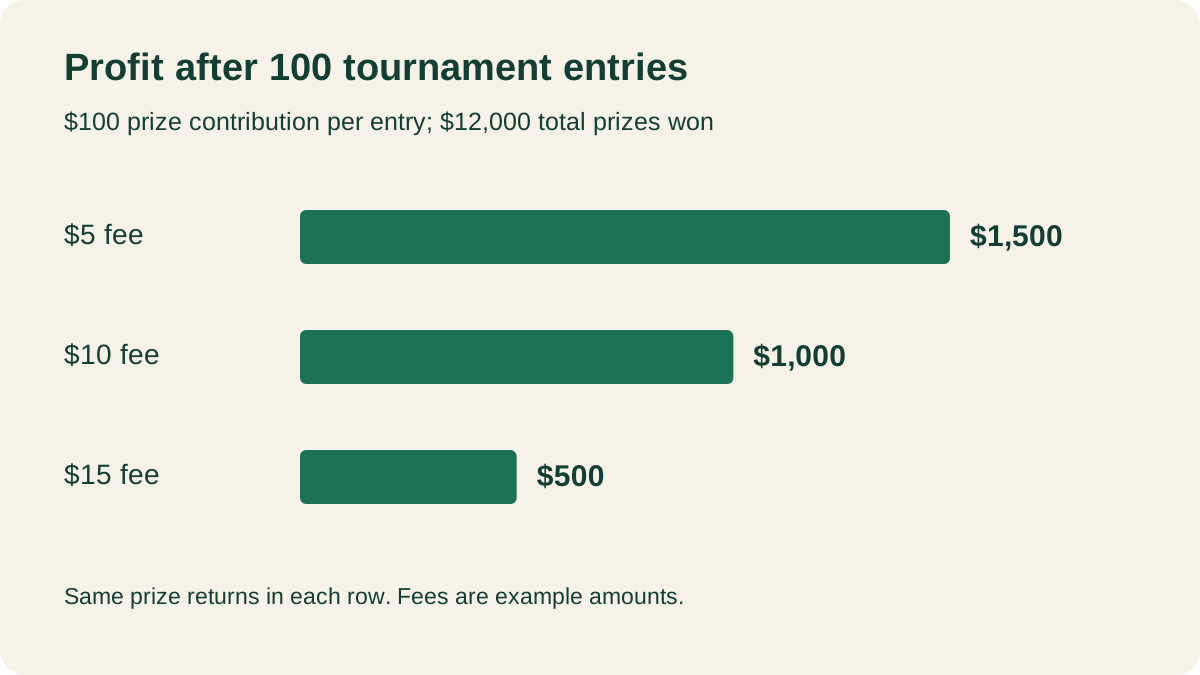
An extra $5 fee per entry costs $500 over 100 entries. If your prize returns stay the same, that can reduce a $1,500 profit to $1,000.
Our example holds the prize contribution at $100 per entry and total prizes won at $12,000. We change only the fee. This lets you see the cost before comparing tournament schedules.
The same $12,000 in prizes at three fee levels
A tournament listed as $100 + $5 costs $105 to enter: $100 goes toward prizes and $5 is the fee. PokerStars explains that tournament rake is paid through the buy-in when you register, rather than on each hand. Check the event's own entry breakdown, since the displayed total can include the fee.
Here is our fixed-return comparison for 100 entries. The fees are examples, not current prices for a named room.
| Fee | Total paid | Profit | ROI |
|---|---|---|---|
| $5 | $10,500 | $1,500 | 14.29% |
| $10 | $11,000 | $1,000 | 9.09% |
| $15 | $11,500 | $500 | 4.35% |
Moving from a $5 fee to $10 uses up one-third of the first row's profit. Moving to $15 uses up two-thirds. None of the prize results changed.
Include the fee before you compare ROI
Return on investment, or ROI, is profit divided by the full amount spent on entries. In the middle row, the calculation is $1,000 divided by $11,000, or 9.09%.
If you count only the $10,000 prize contributions as your cost, you would report $2,000 profit and 20% ROI. That leaves out $1,000 you paid in fees. Use the tournament ROI calculator with the full entry cost and gross prizes returned.
Count each re-entry as another paid entry. Include add-ons and compulsory charges in the cost too. Record travel and accommodation separately if you also want to measure profit from a live trip. Do not add the fee twice when your history already includes it in the total buy-in.
Lower fees do not guarantee higher actual profit. Opponents, field size, structure, and your results can change between events. This comparison isolates the fee; it does not predict your prize returns or identify the most profitable tournament.
How we checked the fee comparison
For each row, total cost is 100 × ($100 + fee). Profit is $12,000 − total cost. ROI is profit ÷ total cost × 100.
The model uses 100 entries, fixed gross prize returns, no rewards, and no other costs. ROI is rounded to two decimal places. The $12,000 return is a chosen example, not an expected result or evidence of a winning skill level.
Source for the fee mechanism: PokerStars tournament rake explanation, checked September 16, 2026. All table figures are our own calculations.

Ryan Taylor
Player Coach · 5 years
Ryan specializes in making poker and crypto accessible to complete beginners. He writes step-by-step guides on everything from setting up a Bitcoin wallet to understanding position at the table. His coaching content focuses on building solid fundamentals before moving up in stakes. Players appreciate his patient, jargon-free explanations. Catches waves at his local break whenever the swell is right.
Read next
Poker cash out fees: what 2% costs on a $500 pot
A $500 all-in model separates rake, cash out fees, and profit. Compare 1% and 2% charges on hand value, with an original cost table.
5 min read
Poker rake caps: when a $3 cap saves you nothing
At 5% rake, a $3 cap starts saving money above a $60 pot. Compare $3 and $5 caps across small pots and a fixed 100-pot sample.
3 min read
Poker re-entry: more chances to cash, more money spent
A second tournament entry can improve your chance of a payout without improving your profit. Our simple $110 example shows why.
3 min read